One mic. Two pioneers. A debate that reaches back to the birth of recorded hip-hop. Doug E. Fresh called himself “The Original Human Beatbox.” Darren “Buffy” Robinson of The Fat Boys became famous as “The Human Beat Box.” They made recognizably different percussion sounds with nothing but their mouths. So who had the more distinctive technique—and what does the surviving evidence actually tell us about who did it first?
This is a four-round archival listening battle, not a manufactured ten-song contest. We have paired four separate Doug E. Fresh recordings or performances with four different Buffy / Fat Boys sources. Play both, read the evidence, and judge the performance rather than the legend.
The showdown: two different ideas of a human drum machine
Early hip-hop needed rhythm everywhere: in clubs, on sidewalks and in moments when a DJ or drum machine wasn’t available. One solution was the human beatbox—a performer who could imitate drums, bass sounds and electronic effects while another MC rhymed. Doug E. Fresh and Darren Robinson turned that emerging idea into something large audiences could recognize. By the middle of the 1980s, both artists were part of the first wave that helped define the form.
Doug E. Fresh — sharp and intricate
Fast clicks, click rolls, precisely separated percussive parts and agile changes of pattern. His beatboxing frequently takes center stage as an independent performance that can also support a storyteller.
Buffy — low-end power and breathing
Thicker bass-like pulses, forceful breathing textures and an immediately recognizable role within the Fat Boys’ group sound. His technique helped make a beatbox part of a group’s character, not just a novelty.
Who was actually first? What the documents can—and cannot—prove
The origin story needs more care than “Doug invented it” or “Buffy did it before Doug.” Doug E. Fresh has publicly described developing his art as a youngster, saying he created it in 1981 and presented it in 1982. Other histories recount Darren Robinson experimenting with the sounds from an early age. Those are historically interesting claims and recollections, but neither is an independently dated recording of the very first human to attempt vocal percussion.
What we can document is the early recorded record: The Fat Boys (then also known as the Disco 3) released “Human Beat Box” as part of their breakout 1984 material; Doug E. Fresh’s early recordings include “Just Having Fun (Do the Beatbox)” and “The Original Human Beat Box.” Museum holdings, contemporary reviews and release documentation help establish those releases. A documented 1984 record is stronger evidence of a released recording than a later interview—but it cannot, by itself, prove who started in a schoolyard first.
A separate performance milestone helps explain why memories conflict: a BOSS history of beatboxing discusses the Disco 3/Fat Boys winning a 1983 Radio City Music Hall talent show with Darren Robinson’s beatbox technique central to the group’s appeal. That is useful evidence of early public performance, but it is not a dated audio master of the first beatbox ever created. The 1983 stage milestone and the 1984 releases answer different historical questions.
Doug’s 1980s nickname and Buffy’s Fat Boys title should be understood as claims within an emerging competitive scene. Hip-hop encouraged performers to declare their uniqueness. This battle will compare what listeners can actually hear, while respecting both artists as pioneers.
Four rounds: Doug E. Fresh vs. Buffy
For the fairest comparison, each round has a stated test. We use original recordings where possible, not fan-made remixes passed off as original tracks. The archival 1984–86 material in the final round is not studio-master quality and should be judged as historical documentation, not as an audiophile test. Some recordings are hosted by independent archivists because a label-verified YouTube copy could not be established.
Round 1
The title fight: the 1984 human-beatbox records
Two era-defining records, but not evidence that either man invented vocal percussion.
DOUG E. FRESH
The Original Human Beat Box
VS
BUFFY / THE FAT BOYS
Human Beat Box
Before anyone declares a winner, these are the two recordings that make the matchup historically meaningful. Doug E. Fresh released “The Original Human Beat Box” through Vintertainment, while The Fat Boys’ self-titled 1984 album included “Human Beat Box.” Both titles put a new musical role front and center: one performer could make a compelling rhythmic track using his mouth rather than a drum machine. Surviving release documentation and museum holdings substantiate both records; they do not, on their own, settle who performed the technique first.
Doug’s record spotlights a remarkable control of rapid clicks, sharply articulated percussion and rhythmic changes. Buffy’s piece emerges from the identity of a three-man act: his heavy, breath-driven sounds are part of the group’s musical personality. Listen closely for where a sound starts, how a bass-like pulse sustains itself, and how a pattern stays recognizable without an instrumental beat doing all the work.
This is the round to play with the least nostalgia. Which 1984 release better conveys the artist’s particular rhythmic identity? The question is not which title makes the stronger claim to being first; a record title is promotion, not a patent.
Your call: Who makes the stronger case on the original-era record alone?
Round 2
Can a human beatbox carry a whole rap performance?
A nearly naked voice-and-beatbox recording against a record where the beatbox is embedded in a group performance.
DOUG E. FRESH
La Di Da Di (with MC Ricky D / Slick Rick)
VS
BUFFY / THE FAT BOYS
Stick ‘Em (The Fat Boys)
“La Di Da Di” is a remarkable demonstration because it strips down the arrangement so far that Doug’s vocal percussion is the rhythmic foundation beneath MC Ricky D’s storytelling. The Library of Congress describes the recording as using no conventional instruments; Doug supplies the drum-machine imitation with mouth, lips, throat and tongue. Its later influence goes far beyond this battle, but it is worth listening as an original 1985 recording before thinking about its many samples and quotations.
Buffy’s role in “Stick ’Em” is different. This 1984 Fat Boys track gives the group a rolling, comic-aggressive feel and an unmistakable vocal hook. Buffy’s beatbox is woven into a broader ensemble record: the point isn’t to remove everything but the human beat; it’s to make the human beatbox part of a group’s signature.
The listening test is role, not identical production. Does Doug’s exposed, almost self-sufficient accompaniment have more impact, or is Buffy’s integration into the trio the more inventive group-music move? The right answer depends on what you value: independence of the rhythm or the way the rhythm becomes a group’s character.
Your call: Would you rather hear the unaccompanied beatbox foundation or the group-driven hook?
Round 3
Performance charisma: turning the technique into a record
Compare two entertaining group records without claiming every sound is entirely live or unprocessed.
DOUG E. FRESH
The Show (with the Get Fresh Crew)
VS
BUFFY / THE FAT BOYS
Can You Feel It (The Fat Boys)
With “The Show,” Doug E. Fresh and MC Ricky D build an entire performance around an exaggerated countdown, voices answering one another and beatbox passages that feel like part of a stage routine. Its original 1985 single is also a reminder that beatboxing was entertainment: Doug was not simply imitating a machine in isolation, he was interacting with a rapper and shaping when the crowd should react.
“Can You Feel It,” from The Fat Boys’ debut-era recordings, demonstrates another way of building energy. The trio used thick, shouted performances, big hooks and room for Buffy’s sounds to define their identity. This round asks which arrangement presents beatboxing as a memorable part of the overall recording, rather than treating the beatbox as a technical exhibition detached from a song.
These are recordings with different production choices. The available “Can You Feel It” music video is a transfer of the original promotional film, with remastered audio; it is not a native HD master or a newly recorded performance. Listen to the balance between voices and rhythm, the timing of a punchline or breakdown, and how a beatbox phrase helps organize the arrangement. Neither side gets automatic points for the song’s sales, later fame or the nostalgic reaction it creates.
Your call: Who turns beatbox technique into a more complete show?
Round 4
The archival-film round: presence without studio polish
Archival recordings—not matched studio audio and not a reconstruction of a head-to-head concert.
DOUG E. FRESH
1986 Dutch television interview and beatbox demonstration
VS
BUFFY / THE FAT BOYS
Archival Fat Boys live human-beatbox performance
Now we leave polished records behind and watch the performers work. Doug E. Fresh appears in 1986 television footage associated with a period when international documentary crews were still explaining New York hip-hop to audiences discovering it for the first time. His sharp transitions and crisp mouth-made percussion are easiest to appreciate when you can see the performer rather than only hear the finished record.
The accompanying early Fat Boys stage clip shows how Darren “Buffy” Robinson’s deeper, breath-driven percussion contributes to the trio’s live identity. Archival footage can be less clean than a master recording; that loss of fidelity is not a performance weakness. What matters is the physical command of sound, the way a groove survives between gestures, and how the crowd or group responds.
These clips were made under different conditions and have reached YouTube through independent archival uploaders. They should not be represented as equal-quality masters, proof of the same event, or a recorded Doug-versus-Buffy face-off. Instead, use them to observe what cannot be captured by a studio credits list: timing, breath control, mic technique and connection with the people in the room.
Your call: Which performer makes the human beatbox more exciting to watch?
What changed after these records?
By 1985, beatboxing had moved from local live routines into iconic singles. Doug E. Fresh and MC Ricky D’s “La Di Da Di” became a foundational recording precisely because it built a full rap performance from speech and human percussion. In 2024, the Library of Congress selected it for the National Recording Registry, recognizing its unusually broad influence. Buffy, meanwhile, helped prove that human vocal percussion could be a stable, memorable feature of a successful rap group rather than a stand-alone special effect.
Their legacies are related, not interchangeable. Doug’s clicks and rhythmic dexterity influenced later precision-oriented beatboxers; Buffy’s bass-heavy approach showed how much bodily air and breath could define the sound. Other pioneers, including Biz Markie, further expanded the vocabulary. Treating one artist as the only inventor obscures the collective experimentation that made this part of hip-hop possible.
Buffy died in 1995. The surviving footage and recordings are especially valuable because they let audiences encounter his technique directly rather than through secondhand superlatives. For a related view of the group, read PCMusicMax’s Fat Boys history, and explore our Rakim vs. Big Daddy Kane comparison for another golden-age listening battle.
Doug E. Fresh or Buffy: your verdict
After four rounds, who made the deeper impression on you? Doug E. Fresh for detailed clicks, rhythmic invention and individual showmanship? Buffy for thick low-end sounds, explosive breathing and the defining role he played in The Fat Boys? Or both, for creating two different blueprints?
This article is a listening comparison, not a declaration that either one stole an idea from the other. Keep your own four-round scorecard as you watch. The comparison does not award automatic points or claim that either artist definitively invented beatboxing.
Frequently asked questions
Did Doug E. Fresh and Buffy have a documented one-on-one beatbox battle?
The artists’ competing claims and nicknames are documented, but this article does not claim to have verified a complete surviving recording or outcome of a formal one-on-one contest. Our four rounds are editorial pairings across different records and archived performances.
Was Buffy a solo artist?
Darren Robinson, also called Buff Love, was the human beatboxer for The Fat Boys. Many examples of his skill survive within recordings and performances by the trio, so those are credited here to Buffy and The Fat Boys where appropriate.
Why only four rounds instead of ten?
Four grounded, distinct comparisons are more useful than reusing a few famous clips, comparing remixes as if they were the originals or claiming unrelated performances took place at the same event. The archival evidence sets the round count—not a content quota.
Are all the embedded videos official high-definition masters?
No. The original studio tracks and early 1980s footage were recorded and preserved under very different conditions. Several vintage clips survive through independent archival uploaders. Where an official label recording is available, it takes priority over an altered version; source authenticity and musical accuracy matter more than an “HD” label alone.
Research sources and recording documentation
- Library of Congress — La Di Da Di, National Recording Registry
- Museum of Pop Culture — Fat Boys / Human Beat Box original 1984 12-inch
- Pollstar — Doug E. Fresh interview on his beatboxing origins
- 1985 Washington Post review of Doug E. Fresh live
- Lyrebird Beatbox School — early beatbox styles and archival examples
- 1985 contemporary review of Just Having Fun
- VPRO Dutch television documentary catalog — Big Fun in the Big Town (1986)
- BOSS — A Brief History of Beatboxing — 1983 Radio City performance milestone and the multiple-pioneer historical context.
- Fat Boys early-historical overview and production
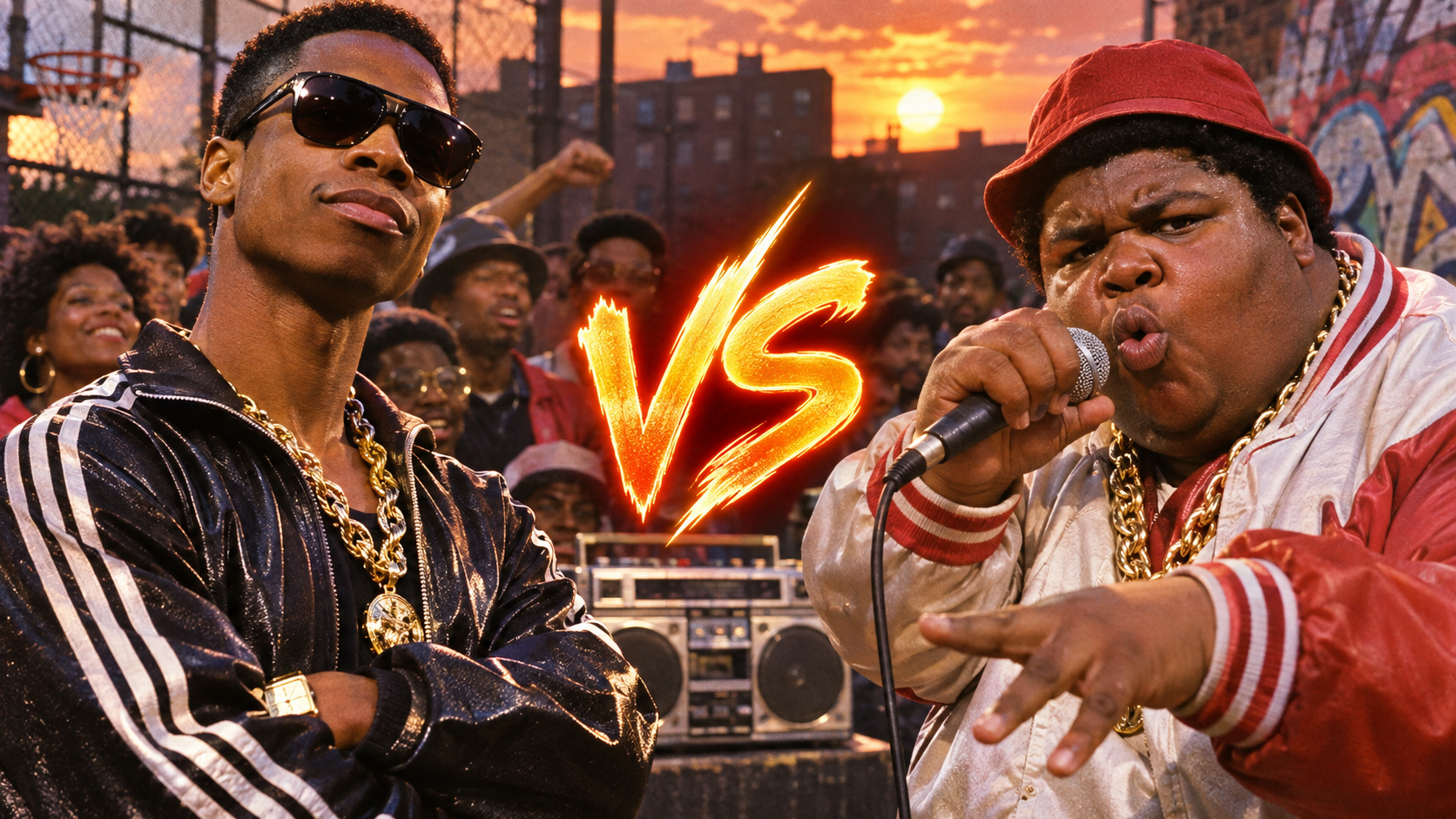
Featured illustration: AI-created editorial artwork depicting Doug E. Fresh and Buffy of the Fat Boys, not an archival photograph or documented shared performance. Editorial note: Embedded video is hosted by third-party YouTube channels; PCMusicMax has not downloaded or re-uploaded the underlying recordings. The archival clips are presented to compare performance techniques, not to verify an unrecorded historical contest. Viewer playback availability and stream quality may vary by country and platform.