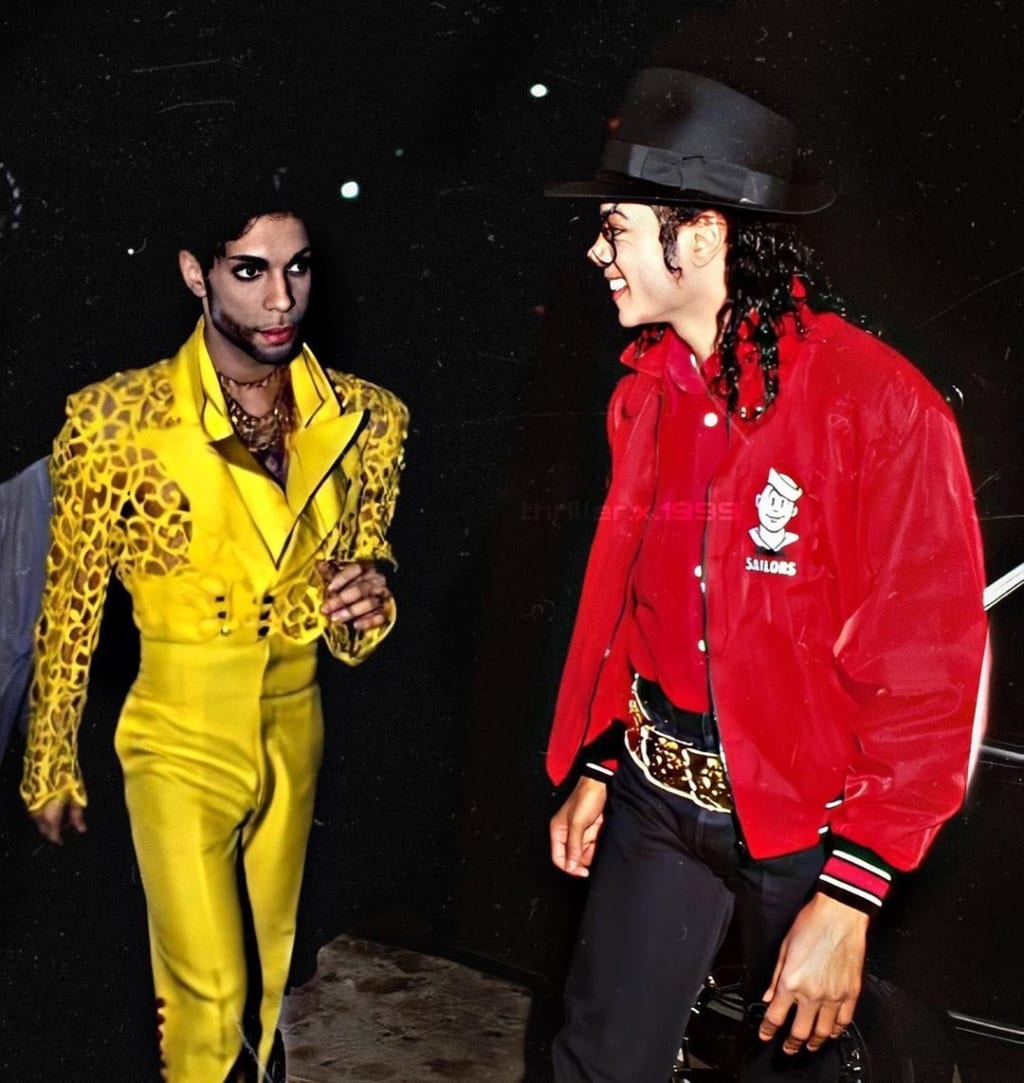
Michael Jackson and Prince spent the 1980s and early 1990s redefining what a pop superstar could sound and look like, but they did it through very different creative systems. Jackson often built records around rhythmic precision, choreography, short-film spectacle and tightly engineered crossover. Prince moved more freely between funk, rock, R&B, psychedelia, pop and band-driven performance, often foregrounding his writing, arranging and instrumental identity.
This is an editorial catalog battle, not a claim that every story told about Jackson and Prince represents a documented personal feud. The format is simple: ten rounds, one representative Michael Jackson song against one representative Prince song, two real YouTube embeds per round, and one overall reader vote at the end. The pairings are based on era, function, musical approach or performance idea—not chart position alone.
How to use the battle: listen before deciding. Consider songwriting, production, vocals, groove, visual presentation, replay value and how well each record represents the artist at that moment. No automatic point system is applied.
Want more head-to-heads? Explore the PCMusicMax Artist vs. Artist battle hub.
Round 1
Dance-floor breakthroughs
Michael Jackson
Michael Jackson — “Don’t Stop ‘Til You Get Enough”
VS
Prince
Prince — “I Wanna Be Your Lover”
What this round tests: the late-1970s breakthrough: two young solo artists turning funk, disco and pop instinct into unmistakable individual identities.
Jackson’s record is all forward motion: layered rhythm, falsetto energy and a groove designed to keep lifting. Prince’s track is leaner and more self-contained, with the performer, writer, arranger and instrumental personality collapsing into one compact pop-funk statement. Listen for how each artist announces independence. Jackson makes the dance floor feel communal and expansive; Prince makes intimacy, groove and control feel like the center of the record.
Your call: watch both sides before moving on. PCMusicMax does not score the round for you—the point is to make the evidence playable and let the reader decide.
Round 2
Signature early-’80s singles
Michael Jackson
Michael Jackson — “Billie Jean”
VS
Prince
Prince — “When Doves Cry”
What this round tests: signature songwriting and production economy: two enormous records built from instantly recognizable rhythmic ideas rather than wall-to-wall instrumentation.
“Billie Jean” locks into an obsessive bass-and-drum pulse and lets tension accumulate around Jackson’s vocal. “When Doves Cry” is equally distinctive for what Prince leaves out as much as what he adds; the arrangement is stark, angular and emotionally unsettled. Both records became calling cards because the production serves the song’s identity immediately. This round is less about which track is ‘bigger’ than which one creates the stronger world with the fewest unnecessary elements.
Your call: watch both sides before moving on. PCMusicMax does not score the round for you—the point is to make the evidence playable and let the reader decide.
Round 3
Rock crossover
Michael Jackson
Michael Jackson — “Beat It”
VS
Prince
Prince & The Revolution — “Let’s Go Crazy”
What this round tests: rock crossover without abandoning pop and R&B instincts.
Jackson’s “Beat It” is precision-engineered crossover: a hard-driving groove, a massive chorus and a guitar spotlight that expands the record’s reach without changing who Jackson is. “Let’s Go Crazy” starts like a sermon and then detonates into a full-band funk-rock rush, with Prince using guitar as part of his own performance identity rather than as a guest color. The question here is whether you prefer Jackson’s tightly constructed crossover architecture or Prince’s live-band voltage and instrumental attack.
Your call: watch both sides before moving on. PCMusicMax does not score the round for you—the point is to make the evidence playable and let the reader decide.
Round 4
Cinematic title tracks
Michael Jackson
Michael Jackson — “Thriller”
VS
Prince
Prince & The Revolution — “Purple Rain”
What this round tests: event-scale storytelling: records that became inseparable from larger visual and cultural experiences.
“Thriller” turns pop into horror theater, with arrangement, sound design and choreography all serving a deliberately cinematic concept. “Purple Rain” moves in the opposite emotional direction: it stretches into a slow-burning rock-soul anthem whose drama comes from performance, dynamics and release. The Prince embed here is the authorized recording rather than an unofficial movie upload. Listen for two different definitions of spectacle—Jackson through tightly staged narrative and Prince through emotional escalation.
Your call: watch both sides before moving on. PCMusicMax does not score the round for you—the point is to make the evidence playable and let the reader decide.
Round 5
Seduction and minimalism
Michael Jackson
Michael Jackson — “The Way You Make Me Feel”
VS
Prince
Prince & The Revolution — “Kiss”
What this round tests: how much personality can sit inside a stripped, rhythm-first romantic record.
Jackson works through bounce, vocal ad-libs and physical performance; the groove is open enough for his phrasing and movement to become part of the song’s identity. Prince takes minimalism even further on “Kiss,” using space, clipped guitar and falsetto to make restraint feel provocative. Neither record needs maximal production to feel huge. This round asks whether you respond more to Jackson’s kinetic charm or Prince’s skeletal funk and sly control.
Your call: watch both sides before moving on. PCMusicMax does not score the round for you—the point is to make the evidence playable and let the reader decide.
Round 6
Romantic storytelling
Michael Jackson
Michael Jackson — “Remember the Time”
VS
Prince
Prince & The Revolution — “Raspberry Beret”
What this round tests: memory, romance and narrative color.
“Remember the Time” wraps nostalgia in polished early-’90s R&B, with a sleek rhythmic bed and one of Jackson’s most elaborate narrative short films. “Raspberry Beret” is lighter on its feet: melodic, psychedelic and conversational, turning a remembered encounter into a vivid miniature. Both records rely on memory, but they frame it differently. Jackson makes recollection feel luxurious and cinematic; Prince makes it quirky, intimate and pictorial.
Your call: watch both sides before moving on. PCMusicMax does not score the round for you—the point is to make the evidence playable and let the reader decide.
Round 7
Motion and character
Michael Jackson
Michael Jackson — “Smooth Criminal”
VS
Prince
Prince — “Little Red Corvette”
What this round tests: character-driven pop: rhythm, persona and visual identity working together.
“Smooth Criminal” is built on clipped rhythmic tension and a fully realized noir-like performance world; Jackson’s vocal and choreography make the record feel almost mechanical in its precision. “Little Red Corvette” is warmer and more suggestive, combining pop-rock sheen with Prince’s gift for metaphor, restraint and melodic tension. One track pushes character outward through choreography and cinematic staging; the other lets character emerge from vocal phrasing, songwriting and band texture.
Your call: watch both sides before moving on. PCMusicMax does not score the round for you—the point is to make the evidence playable and let the reader decide.
Round 8
The social lens
Michael Jackson
Michael Jackson — “Man in the Mirror”
VS
Prince
Prince — “Sign O’ The Times”
What this round tests: two ways of turning pop stardom toward social observation.
Jackson’s “Man in the Mirror” is built as an appeal toward personal responsibility, growing from reflective verses into a large gospel-inflected climax. Prince’s “Sign O’ The Times” is cooler and more observational, moving through contemporary anxieties with a sparse groove that leaves the words exposed. This is a round about framing: Jackson asks for inward change that radiates outward; Prince surveys a troubled world and lets the accumulation of details carry the weight.
Your call: watch both sides before moving on. PCMusicMax does not score the round for you—the point is to make the evidence playable and let the reader decide.
Round 9
Global pop statements
Michael Jackson
Michael Jackson — “Black or White”
VS
What this round tests: large-scale pop messaging built to travel beyond a single genre lane.
“Black or White” combines pop-rock, dance rhythm and a broad social message in a record engineered for global reach. “1999” turns end-of-the-world anxiety into a synth-funk party, making celebration itself the response to uncertainty. Both are expansive pop statements, but their emotional engines differ: Jackson aims for unity and directness; Prince uses irony, apocalypse and release. Which approach feels more durable to you?
Your call: watch both sides before moving on. PCMusicMax does not score the round for you—the point is to make the evidence playable and let the reader decide.
Round 10
Swagger and control
Michael Jackson
Michael Jackson — “Bad”
VS
Prince
Prince & The New Power Generation — “Cream”
What this round tests: self-mythology, confidence and the ability to turn attitude into a complete pop performance.
“Bad” is confrontational and choreographic, with Jackson presenting toughness through clipped vocal attack, group movement and a tightly controlled visual concept. “Cream” is looser and more knowingly playful, with Prince turning confidence into funk-rock strut. The closing round is not about proving who had the larger persona; both did. It is about which artist better converts swagger into a record you want to replay after nine other heavyweight matchups.
Your call: watch both sides before moving on. PCMusicMax does not score the round for you—the point is to make the evidence playable and let the reader decide.
Who won the 10-round matchup?
Finish all ten rounds, then make one overall choice. Cast your vote below for the artist who made the stronger overall case.
Loading ...
Michael Jackson or Prince? The poll is intentionally one overall vote rather than ten separate widgets so the article stays fast and the result measures the reader’s total impression.
Battle methodology
The ten rounds are an editorial listening framework rather than a mathematical ranking. The goal is to avoid ten random greatest-hits pairings. Each matchup has a declared comparison frame—breakthrough record, rock crossover, cinematic scale, romantic storytelling, social commentary, global pop statement or performance attitude—so the reader has a reason to hear the songs side by side.
Only authorized or official-channel YouTube material should survive the final publication gate. Michael Jackson embeds are drawn from his official artist channel. Prince embeds use the official Prince channel or label-authorized audio where an official music-video upload is not the appropriate source. If any embed becomes unavailable, it should be replaced before publication rather than left as a dead player.
PCMusicMax does not claim that these pairings settle which artist was “better.” They create a repeatable comparison format that can generate reader votes, follow-up results coverage and future video episodes while keeping the music itself at the center.
FAQ
Why isn’t every biggest hit included?
A ten-round battle has to make choices. The goal is catalog range and meaningful pairings, not simply sorting both artists by streams or chart peaks. Some major songs can be saved for a sequel, album-vs.-album comparison or a different battle frame.
Is Michael Jackson vs. Prince a documented feud?
This article is presented as an editorial catalog comparison. Jackson and Prince were frequently compared because of their overlapping superstar eras, contrasting creative identities and enormous cultural visibility. PCMusicMax does not treat every rivalry anecdote or fan argument as established fact; a separate historical-rivalry article would require its own sourced chronology.
Why only one final poll?
One overall ballot keeps the page lighter than ten independent poll widgets and gives PCMusicMax one clean first-party signal: after hearing the entire battle, which catalog made the stronger case for that reader?
Sources and video notes