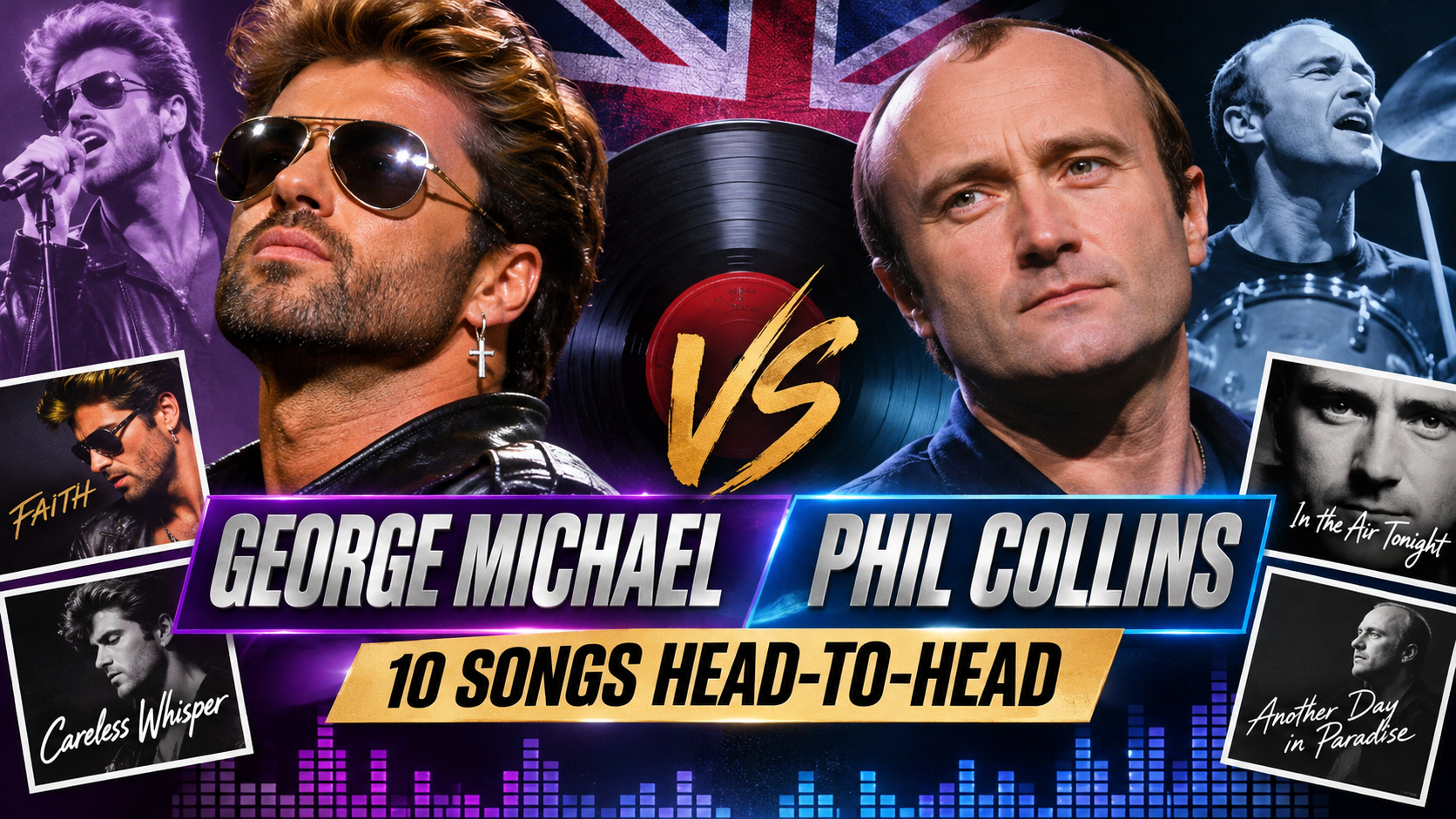
George Michael vs. Phil Collins: 10 Songs Head-to-Head — Who Wins?
George Michael or Phil Collins? Hear 20 official recordings across 10 paired rounds, compare their vocals, songwriting and production, and see our reasoned scorecard.
November 1, 2026PCMusicMax Editorial
George Michael or Phil Collins? Both became defining British voices of the 1980s, but they came at pop stardom from strikingly different directions. Michael could turn a whispered phrase into a showstopping soul performance; Collins could make drums, studio atmosphere and direct storytelling feel like lead characters. This ten-round listening battle puts twenty recordings next to one another so you can hear that contrast instead of settling for a chart-stat argument.
This is an editorial comparison, not a claim of an actual personal feud. Each round pairs recordings for a defined musical quality—vocal delivery, songwriting, groove, arrangement, narrative, or production. The pairings are not required to be released in the same year, and each round explains why its two songs belong together.
Catalog scope: George Michael’s solo-billed recordings, including “Careless Whisper,” and Phil Collins’s solo recordings. No Wham! or Genesis tracks count as contestant recordings. Songwriting collaborators are acknowledged where relevant.
Evidence: official artist-channel videos first; UK chart histories and official music/discography sources for context.
Judgment: each round gets a reasoned editorial edge or draw, but personal taste can legitimately change the outcome. No invented numerical measure of artistic superiority.
Listening: twenty distinct official uploads, presented in equal-size responsive players. Availability can vary by region or rights-holder settings; video playback is handled inside the embedded YouTube player.
Before the bell: the real chart picture
Familiarity is not the same as an argument about musical quality, but the UK Official Charts database shows why this is a serious matchup. As individual credited artists, Michael has seven UK No. 1 singles and twenty-three Top 10 singles; Collins has three UK No. 1 singles and thirteen Top 10 singles. Collins leads on weeks at No. 1 on the UK albums chart, twenty-six to Michael’s seventeen. Those figures are solo-artist profile statistics, not an effort to add Wham! and Genesis achievements to either tally.
Official UK charts
George Michael
Phil Collins
No. 1 singles
7
3
Top 10 singles
23
13
No. 1 albums
7
6
Weeks at No. 1, albums
17
26
The statistics provide scale. The music below provides the contest. Listen for Michael’s controlled soul phrasing against Collins’s instinct for rhythm and arrangement, and decide whether you agree with each editorial call.
Listen and compare: every pair is one complete round. The players stay aligned on wide screens and stack in order on narrow ones.
ROUND 01 · The signature record
Careless Whisper vs. In the Air Tonight
A drum-driven slow burn against a saxophone-led heartbreak classic.
GEORGE MICHAELCareless Whisper1984 · Official video
VS
PHIL COLLINSIn the Air Tonight1981 · Official video
What to listen for
Both tracks announce themselves in seconds. The saxophone melody in “Careless Whisper” is almost a second lead voice, making the song instantly recognizable before Michael enters. Collins uses the opposite kind of suspense: a minimal, uneasy electronic backdrop, close-miked singing and the delayed drum entrance. One track lets melody carry the drama; the other makes the arrangement itself the dramatic event.
Editorial edge: Phil Collins. Michael’s co-written saxophone theme is one of pop’s most durable openings, but the way “In the Air Tonight” releases tension at the drum break gives Collins the narrower production edge. This is a judgment about the complete recording, not an attempt to declare one song more popular.
ROUND 02 · The devastating ballad
One More Try vs. Against All Odds (Take a Look at Me Now)
Two different ways of making a desperate plea feel personal.
GEORGE MICHAELOne More Try1988 · Official video
VS
PHIL COLLINSAgainst All Odds (Take a Look at Me Now)1984 · Official video
What to listen for
The slow gospel-inflected rise of “One More Try” gives Michael room to move from controlled vulnerability into a soaring lead vocal. “Against All Odds” is more cinematic, with Collins singing a direct, tightly focused appeal that grows as the piano and backing arrangement expand. Neither relies on vocal acrobatics alone: the emotional tension comes from how carefully each singer delays the release.
Editorial edge: George Michael. Collins has the more immediate film-ballad construction, yet Michael’s extended phrasing and gradual dynamic climb make “One More Try” the stronger vocal showcase in this particular round.
ROUND 03 · The radio-pop rush
Faith vs. Sussudio
Lean rockabilly-pop swagger meets a full-scale horn-driven dance track.
GEORGE MICHAELFaith1987 · Official video
VS
PHIL COLLINSSussudio1985 · Official video
What to listen for
“Faith” turns a few tightly chosen ingredients—organ introduction, clipped guitar, a crisp beat and Michael’s confident phrasing—into one of the great examples of pop economy. “Sussudio” takes a maximalist route: punchy drums, an instantly repeated hook and brassy rhythmic accents. Their arrangements explain why they belong together: both demand movement without sounding alike.
Editorial edge: Phil Collins. Michael arguably accomplishes more with less. For this groove-first round, however, Collins’s propulsive arrangement and bright rhythmic layering earn a slim edge. The listener can reasonably reverse that choice.
ROUND 04 · Intimacy without spectacle
Father Figure vs. One More Night
Two quiet performances that make restraint the main event.
GEORGE MICHAELFather Figure1987 · Official video
VS
PHIL COLLINSOne More Night1985 · Official video
What to listen for
“Father Figure” blends spacious percussion, an almost whispered vocal entrance and gospel/soul atmosphere into a carefully controlled mood. “One More Night” is deliberately simpler, shaped by its melodic repetition and Collins’s understated, conversational delivery. Neither song needs a huge final chorus to explain its appeal.
Editorial edge: George Michael. The detail in Michael’s breathy lead, the shifts between tenderness and urgency, and the distinctive production space give “Father Figure” the narrow advantage. Collins’s understatement remains an essential counterargument.
ROUND 05 · Songs that look beyond romance
Praying for Time vs. Another Day in Paradise
Social conscience written as reflection versus story.
GEORGE MICHAELPraying for Time1990 · Official video
VS
PHIL COLLINSAnother Day in Paradise1989 · Official video
What to listen for
Michael’s “Praying for Time” sees social divisions and moral exhaustion through an almost hymn-like atmosphere; the arrangement asks the listener to dwell on the questions instead of supplying easy answers. Collins’s “Another Day in Paradise” builds a specific encounter into a recurring plea to pay attention to homelessness and the suffering around us. The songs share serious intentions, but their storytelling methods differ.
Editorial edge: Draw. Michael wins on searching ambiguity and emotional atmosphere; Collins wins on direct narrative accessibility. Neither method cancels the other, so this round is a draw rather than a forced verdict.
ROUND 06 · Freedom, escape and movement
Freedom! ’90 vs. Take Me Home
The sound of breaking away, expressed through two different kinds of release.
GEORGE MICHAELFreedom! ’901990 · Official video
VS
PHIL COLLINSTake Me Home1985 · Official video
What to listen for
“Freedom! ’90” uses a muscular beat, layered vocals and a fiercely self-defining message to turn an argument about artistic identity into a communal pop chorus. “Take Me Home” is more hypnotic: recurring synth and percussion patterns, stacked voices and the sensation of being carried along by momentum. The music videos offer another useful contrast, although the recordings—not celebrity imagery—decide the round.
Editorial edge: George Michael. Collins builds a compelling long-form rhythmic journey. Michael combines equally memorable production with a sharper sense of personal reinvention, giving him the edge in a round about liberation.
ROUND 07 · Late-night ache and texture
Jesus to a Child vs. I Wish It Would Rain Down
A hushed remembrance against a towering, guitar-colored soul lament.
GEORGE MICHAELJesus to a Child1996 · Official video
VS
PHIL COLLINSI Wish It Would Rain Down1989 · Official video
What to listen for
Michael’s “Jesus to a Child” is almost weightless in parts: the soft pulse, carefully spaced vocal lines and melancholy harmonic movement put tenderness at the center. Collins’s “I Wish It Would Rain Down” reaches for a bigger dramatic landscape, with Eric Clapton’s guitar adding a distinct answering voice to the lead vocal. These are not same-year competitors; they are paired for their sustained emotional atmosphere and instrumental storytelling.
Editorial edge: Phil Collins. Michael’s intimacy is extraordinary. This round favors Collins because the interaction between his vocal and Clapton’s guitar creates a second expressive layer rather than merely dressing up the chorus.
ROUND 08 · Dance-pop with personality
Too Funky vs. Two Hearts
A knowing club strut against exuberant Motown-flavored pop.
GEORGE MICHAELToo Funky1992 · Official video
VS
PHIL COLLINSTwo Hearts1988 · Official video
What to listen for
“Too Funky” leans into pulsing dance production, rhythmic vocal play and a sly sense of humor. “Two Hearts,” co-written with Lamont Dozier, finds Collins working inside a retro-soul/pop vocabulary with quick rhythmic hooks and buoyant melodic repetition. Both are overtly fun and show how these singers could shift away from introspective ballads without losing their identities.
Editorial edge: George Michael. Collins makes the retro style work beautifully, but “Too Funky” feels more unmistakably like its singer: playful, self-aware and driven by a production sound that still invites a club-floor listen.
ROUND 09 · What remains after love
A Different Corner vs. Do You Remember?
Minimal vulnerability meets a mature account of regret.
GEORGE MICHAELA Different Corner1986 · Official video
VS
PHIL COLLINSDo You Remember?1990 · Official video
What to listen for
Michael’s “A Different Corner” is defined by open space: a simple keyboard-based setting leaves his voice exposed and makes every change in phrasing matter. Collins’s “Do You Remember?” uses gentler groove and detailed conversational lines to suggest a relationship being reconsidered from a distance. These songs reward attention to ordinary words delivered with unusually careful timing.
Editorial edge: Phil Collins. Michael is perhaps the rawer singer here. Collins takes the round for the complete narrative arc: the arrangement and lyric unfold with a sense of recollection, allowing regret to gather detail as the song continues.
ROUND 10 · The 1990s evolution
Fastlove vs. Everyday
A club-ready late-period reinvention against intimate adult pop.
GEORGE MICHAELFastlove1996 · Official video
VS
PHIL COLLINSEveryday1994 · Official video
What to listen for
“Fastlove” reconnects Michael’s pop appeal with dance-floor production and an assured, unhurried vocal, showing how he could transform his sound without chasing a completely different persona. “Everyday” reveals a different Collins: earnest, direct and more reflective than the huge, brighter productions of his mid-1980s commercial peak. The contrast makes the final round an evolution question rather than a chart contest.
Editorial edge: George Michael. “Everyday” deserves a close listen as songwriting, but “Fastlove” more decisively changes the energy of this head-to-head while retaining its artist’s signature melodic and vocal identity.
Our scorecard: George Michael 5 · Phil Collins 4 · Draws 1
Editorial verdict: George Michael, narrowly. His wins come in vocal intimacy, measured emotional range, artistic reinvention and dance-pop identity. Collins takes rounds where rhythmic architecture, added instrumental voices and narrative development tip the balance. The socially conscious songwriting round is a draw.
That 5–4–1 score is a transparent judgment from the ten musical criteria above—not a calculation of lifetime sales, a claim that one catalog is objectively better, or a prediction of how readers will vote. If the drumming in “In the Air Tonight” matters more to you than the vocal dynamics of “One More Try,” your scorecard may look very different.
Why this comparison opens a bigger music-history story
Both performers emerged from groups into solo careers—George Michael from Wham! and Phil Collins from Genesis—but their paths are not interchangeable. Michael increasingly concentrated the spotlight on his own vocal and songwriting identity. Collins built his solo work out of experience as a drummer, singer and arranger, then moved between ballads, pop, film music and collaborations. A group-to-solo feature can trace that history without claiming these two were rivals.
Critical reputation also changes over time. Research discussed by RTÉ documents the arc of Phil Collins’s early acclaim, later dismissal and renewed appreciation. That is one reason this comparison judges what happens within each recording—the drum sound, phrasing, song construction and replay value—instead of treating changing reputation as a winner’s score.
There is also a striking cover-version connection through Mariah Carey: she recorded George Michael’s “One More Try” for Me. I Am Mariah… The Elusive Chanteuse, and with Westlife recorded the UK chart-topping 2000 version of Collins’s “Against All Odds.” Those are covers, not proof of a sampling relationship. The distinction matters: separate works, recordings and artists form a useful, verifiable discovery path.
Your vote: who wins the full ten rounds?
Who wins your ten-round listening scorecard? Your vote can differ from our editorial 5–4–1 result.
Choose one artist: George Michael or Phil Collins.
Loading ...
Frequently asked questions
Were George Michael and Phil Collins rivals?
This article compares two contemporaneous British solo hitmakers. It does not assert a documented personal feud. “Versus” describes our ten-song listening format.
Why are Genesis and Wham! songs excluded?
Band catalogs introduce different songwriting teams, performance credits and commercial histories. Restricting contestant tracks to solo-billed George Michael and Phil Collins releases creates a more consistent head-to-head. Their group backgrounds remain important context.
Which singer had more UK No. 1 solo singles?
The Official Charts artist pages list seven for George Michael and three for Phil Collins. That does not settle a music-quality debate.
Are all twenty embeds the same quality?
All twenty slots use the same responsive 16:9 player dimensions and prioritize official-channel music videos. Some older source films have different original resolutions or aspect ratios, so picture sharpness can vary even when the players are identical.
Can I listen without accepting an embedded player?
The article does not autoplay the recordings. Select a player to watch or listen through YouTube; availability can vary by location and rights-holder settings.
Featured illustration: An original AI-generated editorial music collage showing George Michael and Phil Collins, with performance imagery and vinyl-record motifs; it is not an archival concert photograph.
Editorial method: scores reflect close listening and clear per-round rationale, not a measurement instrument. Release years and song context were checked against artist channels and discography/chart sources. All music videos are embedded from external rights-holder/official channels; PCMusicMax does not host the music recordings. Media availability may change over time.