DJ Quik vs. MC Eiht is not an imaginary rap rivalry. The two Compton artists spent years trading pointed records before making peace. But their catalogs deserve a wider comparison than the disses alone: Quik helped define a supple, meticulously layered West Coast funk sound; Eiht, first with Compton’s Most Wanted and later on his own, became known for tightly focused stories and an unmistakably measured delivery.
This PCMusicMax battle matches 10 DJ Quik recordings against 10 MC Eiht or Compton’s Most Wanted recordings, with 20 identified YouTube players. Every round has a specific criterion. We compare musical craft and storytelling without treating either man’s real-world feud as entertainment to celebrate.
How this head-to-head works
- Ten themed pairings, one Quik song and one Eiht/CMW song each.
- Each recording uses its original release era; YouTube upload dates may be later.
- Editorial edges are subjective judgments, not verified sales or popularity rankings.
- Compton’s Most Wanted tracks are credited to the group where applicable.
- Listen to both sides, then cast one overall vote in the reader poll.
- The historical feud is explained separately from our modern catalog scorecard.
Content note: several recordings contain explicit language and descriptions of street violence. The historical context matters; discussing these works is not an endorsement of threats or gang activity.
The real DJ Quik–MC Eiht feud: what happened?
Their conflict grew amid Compton’s intensely local early-1990s rap environment, when rival neighborhood affiliations and interpretations of lyrics could carry consequences beyond music. What began as disputed references and perceived insults escalated through songs by DJ Quik, MC Eiht and Compton’s Most Wanted. The Def Wish sequence, Quik’s “Way 2 Fonky” and especially “Dollaz + Sense” became the records most often cited in accounts of that battle.
The origin stories are not perfectly identical. In his retrospective interview for Complex, Quik characterized his early involvement as reluctant and discussed how the dispute developed. In a 2016 interview, Eiht explained how interpreted lines and neighborhood context fed the misunderstanding. These are the artists’ own recollections, not neutral timestamped records of every confrontation.
The public back-and-forth included CMW’s “Def Wish II” video, the “Def Wish III” track on We Come Strapped, and Quik’s blistering “Dollaz + Sense.” Eiht continued the series on Death Threatz. Precise start and end dates vary between retellings; the important documented point is that the feud ended and the men later worked together. Eiht spoke in 2017 about the importance of recording together after years of tension.
That history frames this feature, but it does not determine our winner. A career comparison should also weigh the records that had nothing to do with the feud: Quik’s crowd-moving production, Eiht’s disciplined storytelling, and their distinct contributions to West Coast hip-hop.
Round 1 of 10
The hometown introduction
Compton as birthplace and lived experience
Born and Raised in Compton
1991
VS
Growin’ Up in the Hood
1991 · Compton’s Most Wanted
DJ Quik: Quik uses an elastic, declarative groove to turn a hometown introduction into a declaration of musical arrival. The voice is loose and personable; the beat gives the words room to ride. It is the kind of record that announces not only where an artist comes from but also how he intends to sound.
MC Eiht: Eiht, rapping with Compton’s Most Wanted, offers something closer to an account of how a neighborhood shapes decisions. The storytelling is harder and the mood less celebratory. These songs share a geography but not a thesis: one introduces a rising artist, the other puts a listener inside an environment.
Editorial edge: MC Eiht. The more sustained narrative gives Eiht the narrow storytelling edge, while Quik owns the instantly memorable hometown arrival.
Round 2 of 10
The signature-record test
Two different ways to make a voice unmistakable
Tonite
1991
VS
Streiht Up Menace
1993 · Menace II Society soundtrack
DJ Quik: A day-and-night narrative becomes a rolling party record. The charm is in Quik’s conversational timing, the musical bounce and the way the track makes everyday details feel like a scene worth revisiting.
MC Eiht: Eiht’s film-linked solo breakthrough is a stark account of danger, survival and consequence. His measured delivery leaves space around the grim details. The record became inseparable from the atmosphere of Menace II Society, but it also stands as a complete musical story.
Editorial edge: Tie. Quik has the inviting groove; Eiht has the cinematic tension. Different aims, equally persuasive signature performances.
Round 3 of 10
What Compton sounds like
A trip beyond the city versus the cost of remaining inside it
Jus Lyke Compton
1992
VS
Hood Took Me Under
1992 · Compton’s Most Wanted
DJ Quik: Quik’s record travels outside his hometown and finds familiar patterns elsewhere. The bright arrangement moves forward with the ease of a travelogue even while its lyrics describe difficult, recognizable conditions in different cities.
MC Eiht: Eiht’s CMW classic turns inward. The refrain describes the pull of an environment that can overwhelm its narrator; the verses build a trajectory instead of a collection of observations. It is one of the strongest statements of Eiht’s narrative identity.
Editorial edge: MC Eiht. Eiht builds the more emotionally cumulative story; Quik offers the wider geographic view.
Round 4 of 10
The 1990s West Coast sound
Polished funk production versus an understated street groove
Safe + Sound
1995
VS
All for the Money
1994 · MC Eiht featuring CMW
DJ Quik: Quik’s low-end balance, melodic layers and confident rhythmic spacing show why he became so important as a producer as well as an MC. The groove is detailed without becoming crowded: the instrumental is part of the lead performance.
MC Eiht: Eiht and DJ Slip make a different production choice. The beat moves with a cooler, darker steadiness, providing Eiht a controlled platform for blunt observations. Its strength is discipline, not decorative complexity.
Editorial edge: DJ Quik. Quik’s arrangement and polish provide more to unpack on repeated production-focused listening.
Round 5 of 10
The diss-track confrontation
The feud in its sharpest recorded form
Dollaz + Sense
1994 soundtrack / 1995 album
VS
Def Wish III
1994 · MC Eiht featuring CMW
DJ Quik: Quik brings a deceptively buoyant funk beat to an openly hostile personal response. The contrast is what makes the record so memorable: its music invites a head-nod while the vocal targets a specific rival. The song is evidence of a bitter time, not an endorsement of what was said.
MC Eiht: Eiht answers within the continuing Def Wish series, with a harder, less playful attack and the weight of years of accumulated tension. It is a record to hear in context: its impact comes from what preceded it as much as from its delivery.
Editorial edge: DJ Quik. Quik’s juxtaposition of musical accessibility and pointed battle writing makes the more distinctive recording. This is an editorial judgment about these tracks, not a verdict on their real-life conflict.
Round 6 of 10
The feud before the peak
Early musical replies and visual escalation
Way 2 Fonky
1992
VS
Def Wish II
1992 · Compton’s Most Wanted
DJ Quik: Quik makes an assertive, bright-sounding performance whose musical confidence can almost distract from the competitive edge. The melodic funk structure offers a useful counterpoint to his sharper bars.
MC Eiht: CMW’s official Def Wish II video gives the rivalry a concrete visual dimension and is among the clearest artifacts of how public the antagonism became. Eiht’s delivery is unforgiving and the video imagery is confrontational.
Editorial edge: MC Eiht. The combination of musical reply and unmistakable official video gives CMW the stronger audiovisual battle document.
Round 7 of 10
Who sounds most convincing?
Two kinds of self-definition after the first explosions
You’z a Ganxta
1998
VS
We Come Strapped
1994 · MC Eiht featuring CMW
DJ Quik: Quik sounds observant and increasingly reflective about what the label of ‘gangsta’ means, complicating a persona that earlier records could present more simply. The performance is economical and the musical setting feels lived-in rather than merely flashy.
MC Eiht: Eiht’s title track is resolute and tightly focused on the stance that defines his 1994 project. The groove is steady and the vocal stays grounded in its own perspective.
Editorial edge: DJ Quik. Quik earns the edge by widening the question beyond posture into an examination of identity.
Round 8 of 10
Bounce, street rhythm and replay
Dance-floor funk contrasted with early CMW minimalism
Pitch In on a Party
2000
VS
One Time Gaffled Em Up
1990 · Compton’s Most Wanted
DJ Quik: Quik leans into the rubbery party sound that makes his production recognizable immediately. Bass, rhythm and vocal cadence are engineered for movement and replay. The record may not be his most serious, but seriousness is not the test here.
MC Eiht: CMW’s early record carries the rougher feel of a group still defining its sound. Rather than offering the same party mood, it brings tougher storytelling, older-school percussion and a leaner arrangement.
Editorial edge: DJ Quik. For this explicitly groove-and-replay round, Quik’s instrumental and hook make the clearer case.
Round 9 of 10
Commanding the supporting cast
Group chemistry and featured voices
Hand in Hand (feat. 2nd II None & El DeBarge)
1998
VS
Thuggin It Up
1996 · MC Eiht
DJ Quik: Quik creates an ensemble setting where 2nd II None and the record’s smooth melodic structure broaden his usual solo perspective. His production functions as the glue: distinct voices feel like parts of the same arrangement.
MC Eiht: Eiht’s mid-1990s solo identity is more forceful. The vocal carries the track through repetition, a blunt rhythmic pocket and an unchanging sense of conviction.
Editorial edge: DJ Quik. The more intricate interplay of featured performers and arrangement gives Quik the ensemble edge.
Round 10 of 10
The later-career reset
Veteran voices operating beyond the original feud
Nobody (feat. Suga Free)
2011 · video also features Ty Dolla $ign
VS
Got That (feat. DJ Premier)
2017
DJ Quik: Quik reconnects with the chemistry of Suga Free while keeping his distinctive pocket intact. The video foregrounds creative partnership rather than replaying the antagonism of the early 1990s.
MC Eiht: Eiht delivers disciplined veteran rap over Brenk Sinatra’s production, with DJ Premier contributing the call-and-response hook. The hook’s call-and-response and tightly framed delivery emphasize authority without requiring a return to feud-era shock value.
Editorial edge: MC Eiht. For a concise, lyric-centered veteran statement, Eiht’s performance with Premier delivers the tighter argument.
Final scorecard: DJ Quik 5, MC Eiht 4, one tie
Our editorial score is DJ Quik 5 — MC Eiht 4 — tie 1. That narrow result follows the criteria stated at the start of each round, not assumptions about album sales, neighborhood authenticity or a supposed objective consensus. Different criteria could reasonably change the result, especially if storytelling carries more weight than arrangement and replay value.
| Round | Listening test | Editorial edge |
|---|---|---|
| 1 | The hometown introduction | MC Eiht |
| 2 | The signature-record test | Tie |
| 3 | What Compton sounds like | MC Eiht |
| 4 | The 1990s West Coast sound | DJ Quik |
| 5 | The diss-track confrontation | DJ Quik |
| 6 | The feud before the peak | MC Eiht |
| 7 | Who sounds most convincing? | DJ Quik |
| 8 | Bounce, street rhythm and replay | DJ Quik |
| 9 | Commanding the supporting cast | DJ Quik |
| 10 | The later-career reset | MC Eiht |
The clearest split: Quik takes the production-heavy and ensemble rounds; Eiht is strongest when a sustained neighborhood narrative or a stark vocal focus carries the recording. That is why “Tonite” versus “Streiht Up Menace” is a tie: the music succeeds for fundamentally different reasons.
The actual on-wax feud should not be collapsed into this 10-round total. Tracks such as “Def Wish IV” and “Let You Havit” belong to the full history even though our format chooses just one song per performer in each round.
Vote: Who wins DJ Quik vs. MC Eiht?
Choose your winner.
One vote per reader.
Frequently asked questions
Did DJ Quik and MC Eiht really have a feud?
Yes. They traded songs over a period of years, and both have addressed the history in interviews. The exact chronology and interpretations of how it started differ between accounts, so this article distinguishes verifiable records from retrospective testimony.
Which song is DJ Quik’s diss toward MC Eiht?
“Dollaz + Sense” is the best-known direct response associated with the dispute. It appeared on the Murder Was the Case soundtrack in 1994 and on Safe + Sound in 1995. Other tracks, including “Way 2 Fonky,” are part of the broader exchange.
What were MC Eiht’s reply records?
The Def Wish series—initially with Compton’s Most Wanted, then on Eiht-billed releases—is central to the story. “Def Wish II,” “Def Wish III” and the later “Def Wish IV (Tap That Azz)” are notable examples.
Are the two rappers still enemies?
No. The feud ended, and MC Eiht has publicly described working with Quik afterward. It would be inaccurate to present their 1990s tension as a current personal conflict.
Why does this battle include Compton’s Most Wanted?
MC Eiht’s influential early recordings were released under Compton’s Most Wanted. Excluding those tracks would erase the group context essential to his musical contribution and to the history of the feud.
Keep listening: more PCMusicMax battles and hip-hop history
Continue with Rakim vs. Big Daddy Kane and Jay-Z vs. Nas, then explore how Rakim changed rap flow or all Artist vs. Artist battles.
Sources and verification
- Complex: DJ Quik explains the origins and making of key records — first-person account of songs including “Way 2 Fonky” and “Dollaz + Sense.”
- VladTV: MC Eiht on how the feud developed and ended (2016) — first-person history.
- VladTV: MC Eiht on working with Quik after the rivalry (2017) — reconciliation context.
- AllMusic: MC Eiht discography and biography and Apple Music: MC Eiht catalog — release and group-credit cross-checks.
- Apple Music: DJ Quik catalog and Quik’s record-by-record interview — song and career cross-checks.
- SPIN: MC Eiht on creating “Streiht Up Menace” (2026) — first-person recording and film context.
- The Ringer: ranking and context for the Def Wish series (2024) — comparative historical editorial reference.
- Albumism: Compton’s Most Wanted, Music to Driveby retrospective — the 1992 album and rivalries in context.
- XXL: “Got That” release and production credits — confirms Brenk Sinatra production and Premier’s hook.
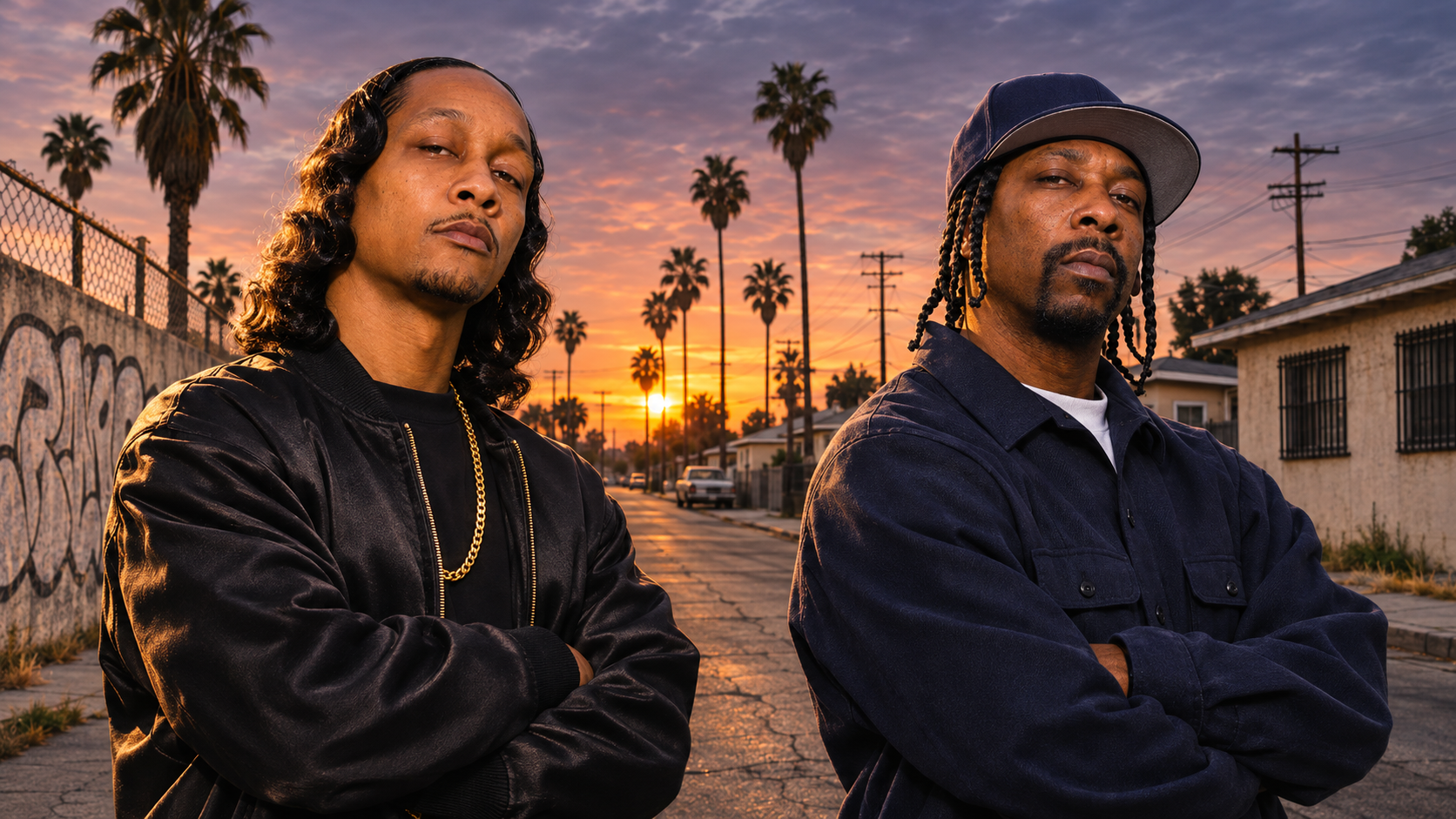
Featured image: AI-created editorial illustration, not an archival photograph of the artists together.
Video/source note: Music and videos are embedded from third-party YouTube channels including artist, VEVO and label-generated Topic accounts where available. The embedded videos remain the property of their respective owners; YouTube may restrict playback by country, age or device. A source link below each player offers a direct route to the recording.