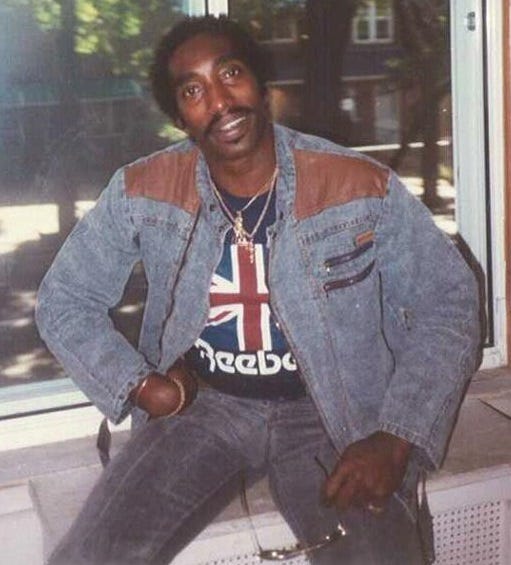
Larry Smith helped shape the sound of early recorded hip-hop through work with Orange Krush, Jimmy Spicer, Run-D.M.C., Whodini, Lovebug Starski, Grandmaster Flash and others. This chronological PCMusicMax timeline traces his verified production, songwriting, musicianship and studio credits from the late 1970s forward, then follows the samples, remixes and covers that carried his sound into later generations.
For every listed track, the article highlights the most important sampling, source, remix or cover relationships shown in that snapshot, then lets you hear the record through an embedded YouTube player. Database conflicts are labeled rather than treated as settled fact.
Background
Larry Smith entered hip-hop as a Queens musician and bassist before becoming one of early rap’s defining producers. His work around Kurtis Blow and Orange Krush helped bridge live-band rap into the leaner drum-machine era. The timeline below begins with the oldest tracks in the seven-page WhoSampled file and follows the catalog forward year by year.
Larry Smith Career Timeline — WhoSampled Core + Verified Discography
WhoSampled provides a useful map of Larry Smith’s sample, remix and cover relationships, but it does not capture every important credit. The timeline below therefore combines those relationships with verified production, songwriting, musicianship and studio credits from album documentation, interviews and other supporting sources. Each year moves chronologically, with notable downstream samples and source records included where they help show how Smith’s work traveled across generations. Conflicting credits are identified when the evidence does not support a single clean attribution.
1979–1980: Kurtis Blow and the First Recorded-Rap Foundation
Before Larry Smith became the producer most closely associated with Run-D.M.C. and Whodini, he was already part of the studio network around Kurtis Blow. These early credits matter because they show Smith first as a musician, arranger and writer before his later producer identity fully formed.
Kurtis Blow — “Christmas Rappin’” (1979)
Smith played bass on Kurtis Blow’s breakthrough “Christmas Rappin’.” He was not the credited producer, so this belongs in the timeline as an early session-musician credit rather than as a Larry Smith production. The record put him inside one of rap’s first major-label breakthroughs and connected him with the team that would shape his next several years.
Kurtis Blow — “Rappin’ Blow, Pt. 2” (1980)
Smith is credited as a composer on “Rappin’ Blow, Pt. 2.” The track is important to his development because his role was moving beyond hired musicianship into authorship of the musical framework itself.
Kurtis Blow — “The Breaks” (1980)
Smith is one of the credited writers of “The Breaks,” alongside Kurtis Blow, Robert Ford Jr., J.B. Moore and Russell Simmons. That songwriting connection is central to Smith’s pre-Run-D.M.C. story: one of early rap’s landmark crossover records already carried his musical authorship years before his name became synonymous with production.
Kurtis Blow — “Hard Times” (1980)
Smith co-wrote “Hard Times” and also played on the original Kurtis Blow recording. Run-D.M.C. later covered the song, creating a direct bridge between Smith’s early work with Blow and the stripped-down new-school sound he would help create with Run and D.M.C.
1981: Writing Credits Before the Producer Breakthrough
Kurtis Blow — “The Deuce”
Copyright and release records credit Smith with the music for “The Deuce.” The album itself was produced by J.B. Moore and Robert Ford Jr., so Smith’s role here is songwriting/composition rather than album production.
Kurtis Blow — “Take It to the Bridge”
Smith also received a writing credit on “Take It to the Bridge,” with copyright records specifically identifying him as a music author. Together with “The Deuce,” the credit shows that his harmonic and rhythmic ideas were already being documented as compositions before he became a headline producer.
1982
Kurtis Blow — “Tough”
Smith is credited as a composer on the title track of Kurtis Blow’s Tough. This is another documented step in the transition from session musician to writer and producer.
Kurtis Blow — “Daydreamin’”
“Daydreamin’” also carries a Larry Smith writing credit. Copyright records list Smith, Kurtis Blow and J.B. Moore among the authors, adding another verified pre-Run-D.M.C. composition to the chronology.
Smith’s 1982 entries already show the two sides of the producer he would become: the hard, open rhythm architecture of Orange Krush and the longer-form rap construction of Jimmy Spicer. These records are important not only because they came before Run-D.M.C., but because later producers repeatedly returned to them as source material.
Orange Krush — “Action”
Produced by Larry Smith and Russell Simmons, “Action” is one of the clearest bridges between Smith’s live-band years and the machine-driven language that followed. WhoSampled connects it to later records including Kanye West’s “We Major,” Jay-Z and Kanye West’s “Primetime,” and Michel’le’s Dr. Dre-produced “Nicety,” making a 1982 New York groove part of the vocabulary of later East Coast, West Coast and mainstream rap production.
Jimmy Spicer — “The Bubble Bunch”
Smith’s production work with Jimmy Spicer gave him room to shape an extended narrative rap record rather than only a short single. “The Bubble Bunch” later fed records by MC Lyte and Busta Rhymes, while the track itself drew on Tom Browne’s “Thighs High,” illustrating how early hip-hop was already becoming a conversation between funk records, live musicianship and new rap production.
1983
By 1983 Smith was no longer merely a musician moving through rap sessions. His credits connected Jimmy Spicer, Run-D.M.C., Lovebug Starski and Dynamite Two, and the records reveal a producer learning how to make sparse drum programming, hooks, live ideas and street-level performance coexist. Several of these tracks became heavily reused building blocks years later.
Jimmy Spicer — “Money (Dollar Bill Y’all)”
“Money (Dollar Bill Y’all)” is one of Smith’s most durable pre-Run-D.M.C. productions. Later uses include Wu-Tang Clan’s “C.R.E.A.M.,” Montell Jordan’s “This Is How We Do It” and Kanye West’s “Eyes Closed,” which means a 1983 Larry Smith production became raw material for landmark rap and R&B records across multiple decades.
Run-D.M.C. — “Sucker M.C.’s (Krush Groove 1)”
“Sucker M.C.’s” turned scarcity into an aesthetic: exposed drums, enormous vocal space and very little decoration. Its documented afterlife reaches from Run-D.M.C.’s own “Rock Box” to 2Pac’s “Got My Mind Made Up” and even Aphex Twin, showing how a minimal early-rap construction could remain useful to artists working in completely different styles.
Run-D.M.C. — “Jam-Master Jay”
On “Jam-Master Jay,” Smith helped turn DJ identity itself into the subject of a record while building from older rhythmic material including the Magic Disco Machine’s “Scratchin’” and Cerrone’s live “Rocket in the Pocket.” The track’s later reuse demonstrates the circular nature of hip-hop production: a record built from earlier dance-floor ideas becomes a source for another generation.
Run-D.M.C. — “It’s Like That”
Smith described the Oberheim DMX and Prophet-5 as core tools behind “It’s Like That,” but the importance of the record is larger than the equipment list. Its stern, uncluttered pulse helped define Run-D.M.C.’s identity, and later connections ranging from Snoop Dogg to Jagged Edge and electronic remakes show how portable that rhythmic framework became.
Lovebug Starski — “Starski Live at the Disco Fever”
“Starski Live at the Disco Fever” preserved part of the live-club personality that recorded hip-hop was still learning to capture. WhoSampled later connects the Larry Smith-produced track to Common and Pharrell’s “Universal Mind Control,” the Beastie Boys’ “B-Boy Bouillabaisse” and Public Enemy’s “Can’t Truss It,” extending Starski’s club energy deep into later rap history.
Lovebug Starski — “You’ve Gotta Believe”
This Smith-produced Starski record shows that his 1983 workload was not limited to Run-D.M.C.’s emerging sound. Later database connections include Marky Mark and the Funky Bunch and Resident Alien; the WhoSampled profile also reports a connection to the Smiths’ “How Soon Is Now?,” a reminder that database relationships can cross genre boundaries and deserve track-level verification rather than assumptions.
Run-D.M.C. — “Hard Times”
Run-D.M.C.’s “Hard Times” is especially useful for understanding lineage because it reworks a Kurtis Blow song from Smith’s earlier creative orbit. Later sampling by Coldcut and the Goats adds another layer, turning the record into a bridge from Kurtis Blow to Run-D.M.C. and then into the sample-based era that followed.
Dynamite Two — “Can’t Stop (Till I Reach the Top)”
The Dynamite Two entry widens Smith’s 1983 map beyond the better-known Profile and Jive stories. WhoSampled identifies older funk and soul material including Uncle Louie’s “I Like Funky Music” remix and Curtis Mayfield’s “Freddie’s Dead” inside the track’s relationship graph, making it another example of Smith operating inside the broader break-and-groove vocabulary of early rap.
1984
1984 is the year Smith’s two most famous production relationships become impossible to ignore. Run-D.M.C. pushed toward hard minimalism and rock crossover while Whodini proved that the same producer could build melodic, R&B-aware rap records. The WhoSampled pages also preserve alternate, live and instrumental versions that later producers treated as separate pieces of usable audio history.
Dr. Jeckyll & Mr. Hyde — “Fast Life”
“Fast Life” belongs in the Larry Smith chronology as a songwriting credit rather than a production credit. Current Apple Music and Shazam metadata credit William Waring, Kurtis Blow and Larry Smith as composers, while period/reissue documentation identifies Kurtis Blow as the producer. That distinction matters: Smith’s writing was still feeding other Rush-associated records even when he was not the person producing the session.
The Fat Boys — “Jail House Rap”
The WhoSampled Larry Smith profile does not surface the Fat Boys, but the broader credit record does. On the Fat Boys’ 1984 debut, Smith was part of the studio team as a musician/drum-machine contributor, and “Jail House Rap” carries a Larry Smith composition credit. Davy DMX later recalled that Smith began work on the song before other obligations pulled him away and Davy finished the record with Kurtis Blow. Kurtis Blow remains the principal credited producer, so this is best described as a major Smith writing and studio contribution rather than a solo Larry Smith production.
Whodini — “Featuring Grand Master Dee”
Every original track on Whodini’s Escape was produced by Larry Smith. “Featuring Grand Master Dee” is therefore part of the verified 1984 production record even though it is absent from the seven-page Larry Smith WhoSampled results. No major downstream sample relationship was surfaced in the captured WhoSampled profile, but omitting the track would incorrectly reduce Smith’s work on Escape to only the songs with documented sample connections.
Whodini — “Out of Control”
“Out of Control” is another Smith-produced Escape album cut omitted by the Larry Smith WhoSampled artist page. AllMusic credits Smith as the composition’s sole writer, strengthening its place in a complete production timeline even without a headline sample afterlife.
Whodini — “We Are Whodini”
The closing track of Escape was also produced by Smith and co-written by Smith, Jalil Hutchins and Ecstasy. It belongs in the chronology because the purpose of the expanded timeline is to document the verified production catalog first, then layer sample history on top of it rather than letting sample-database visibility determine what counts.
Whodini — “Friends”
“Friends” may be the strongest single proof that Smith’s smoother productions were every bit as influential as his harder Run-D.M.C. work. Later uses include Kanye West’s “Real Friends,” Nas and Lauryn Hill’s “If I Ruled the World (Imagine That)” and 2Pac’s “Troublesome ’96,” giving one Whodini groove an afterlife across several generations of rap songwriting.
Run-D.M.C. — “Rock Box”
“Rock Box” is where Smith’s willingness to add live guitar helped move rap into territory that radio and MTV could not easily categorize. Its later sample trail includes the Pharcyde’s “Runnin’,” Jay-Z’s “Where I’m From” and 2024’s “BACK TO ME,” demonstrating that the record’s drums and guitar-era attitude remained useful long after rap-rock stopped being a novelty.
Whodini — “Five Minutes of Funk”
Smith’s production on “Five Minutes of Funk” balanced club force with melodic control, and that balance helped make it unusually reusable. WhoSampled connects it to Jermaine Dupri and Ludacris’ “Welcome to Atlanta,” 2Pac material and Kesha’s “Tik Tok,” evidence that the record’s rhythmic DNA traveled far beyond old-school rap nostalgia.
Run-D.M.C. — “Hollis Crew (Krush Groove 2)”
“Hollis Crew” carries the Krush Groove naming directly into Run-D.M.C.’s Queens identity. Later connections to Kanye West’s “Gorgeous,” Mariah Carey’s “It’s Like That” and Run-D.M.C.’s own live catalog show the record functioning both as a hometown statement and as a reusable rhythmic source.
Whodini — “Freaks Come Out at Night”
“Freaks Come Out at Night” gave Whodini a theatrical club record without sacrificing the punch of Smith’s rhythm track. Its later appearances in work by the Game and 50 Cent, Travis Scott and dance producer Cevin Fisher show how the song could be reinterpreted as West Coast rap, trap-era atmosphere or club music.
Whodini — “Escape (I Need a Break)”
“Escape (I Need a Break)” matters twice: first as part of the album that established Smith’s solo-production identity with Whodini, and later as source material for J Dilla. WhoSampled links it to multiple Jay Dee/Dilla works, which places Smith’s 1984 programming and arrangement inside the lineage of one of the most studied producers of the next generation.
Run-D.M.C. — “Wake Up”
“Wake Up” is a less-discussed Smith production from the debut-era catalog, but its later reuse by Snoop Dogg is exactly why a comprehensive chronology matters. The headline singles tell only part of the story; album cuts also carried rhythmic ideas forward into later regional styles.
Run-D.M.C. — “Jay’s Game”
“Jay’s Game” folds earlier Run-D.M.C. material back into a DJ-centered construction, including elements connected to “Jam-Master Jay” and “It’s Like That.” It is a useful reminder that reuse inside hip-hop did not begin only when outside producers sampled the catalog; artists and DJs were already recombining their own recorded vocabulary.
Run-D.M.C. — “30 Days”
“30 Days” expands the 1984 record beyond the songs most histories repeat. WhoSampled later connects the Smith-produced track to UNKLE’s “Intro (Optional),” a small but revealing example of how Run-D.M.C. album material entered the crate-digging vocabulary of later alternative and electronic production.
Run-D.M.C. — “Sucker M.C.’s (Live on Graffiti Rock)”
The Graffiti Rock performance deserves its own entry because WhoSampled treats the live recording as a distinct source. That live version was later sampled by Skillz, showing that performance recordings—not only studio masters—became part of hip-hop’s reusable archive.
Whodini — “Friends (Instrumental)”
The instrumental version isolates Smith’s arrangement from Whodini’s vocal narrative and makes the production itself easier to study. Its later appearance in a DJ Seith remix underscores why instrumentals matter to sample history: they expose bass, drums and melodic space without the original vocals competing for attention.
1985
By 1985, Larry Smith’s WhoSampled-listed footprint had widened beyond the breakthrough records of 1983–84. The twelve 1985 entries include major Run-D.M.C. cuts, Whodini productions, remix work, Con Funk Shun, and one disputed soundtrack credit. Read together, they show both the reach of Smith’s production network and why a comprehensive chronology has to distinguish firm credits from database conflicts.
Rappin’ — music supervision and original soundtrack productions
One of the largest omissions in a WhoSampled-only reconstruction is Smith’s work on the 1985 film Rappin’. AFI credits Larry Smith as the film’s music supervisor, and contemporary Billboard reporting said Smith was providing music for the production. The soundtrack credits also identify him as producer or co-producer on a substantial group of original pieces: Lovebug Starski’s “Rappin’,” “Snack Attack,” “Dodge,” “Colors,” “Lady Alcohol,” “The Game,” LaJuan Carter’s “FU12,” “Courtroom” and “Finale.” Several of those songs also carry Smith writing credits. This project deserves its own place in the chronology because it shows Smith functioning as a film music supervisor, songwriter and producer at the same time he was making landmark rap albums.
King of Rock — Run-D.M.C.
WhoSampled lists Larry Smith as producer on Run-D.M.C.’s 1985 “King of Rock.” Its later reuse crossed genres and generations: the file highlights Michael Jackson’s “2 Bad,” Eazy-E’s “Radio,” and Kurious’ “Fresh Out the Box,” with many more connections behind them. That range helps explain why Smith’s hard, open arrangements remained useful long after the record’s original moment.
Rock the House — Run-D.M.C.
“Rock the House” is another 1985 Smith production that became a source for later hip-hop. The WhoSampled file surfaces Beastie Boys’ “Sure Shot,” Public Enemy’s “Night of the Living Baseheads,” and DJ Flavours’ “Rock Da House.” The important point is not simply that the song was sampled; it is that Smith’s rhythmic construction stayed adaptable across radically different production eras.
Big Mouth — Whodini
Whodini’s “Big Mouth” shows Smith working in a different palette from Run-D.M.C. while still creating material that later producers could repurpose. WhoSampled connects the record to Porn Kings’ “Up to No Good,” 2 Live Crew’s “Dick Almighty,” Floorfilla’s “Anthem #2,” and dozens of additional uses. The record’s afterlife reinforces how Smith could make crossover-friendly music without losing a strong rhythmic core.
You Talk Too Much — Run-D.M.C.
On “You Talk Too Much,” Smith’s production became part of another cross-genre chain. The file points to Anthrax’s “I’m the Man,” Run-D.M.C.’s own “You Be Illin’,” and Jungle Brothers’ “In Dayz 2 Come.” That movement from rap into rap-metal and back into later hip-hop is another example of the catalog’s unusual durability.
Jam Master Jammin’ — Run-D.M.C.
WhoSampled identifies “Jam Master Jammin’” as a Larry Smith production that draws from Billy Squier’s “The Big Beat.” It was later remixed by Russell Simmons and Smith, and the original also fed later work including Brother Ali and Slug’s “The Believers.” This is an important bridge between Smith’s composition-driven approach and the increasingly sample-aware production culture surrounding him.
Darryl and Joe (Krush Groove 3) — Run-D.M.C.
The third “Krush Groove” entry makes the Orange Krush lineage explicit in the title itself. WhoSampled connects it forward to Da Brat’s “Got It Poppin’,” Dev Large’s “Dead Funky President,” and Grandmaster Flash’s “Get Yours.” In the larger Larry Smith story, this track is evidence that the rhythmic ideas born around Orange Krush were not a one-record accident; they became a reusable production vocabulary.
Can You Rock It Like This? — Run-D.M.C.
“Can You Rock It Like This?” appears in the file with later connections to Baha Men’s “Move It Like This” and J Rocc’s “Rocchead’s Delight.” It belongs in the chronology because Smith’s influence did not depend only on the handful of singles that became household names; album tracks also continued to circulate through DJ and producer culture.
Call Me — D. Terrell (database credit conflict)
WhoSampled places D. Terrell’s 1985 “Call Me” on Larry Smith’s profile with a producer credit and connects it forward to Boldy James and Action Bronson’s “Traction.” That attribution is not cleanly supported by every external credit source, however: soundtrack documentation attributes the production elsewhere. PCMusicMax is therefore preserving the WhoSampled entry because it appears in the seven-page file while flagging the credit as disputed rather than silently converting a database listing into a settled fact.
Jam Master Jammin’ (Remix) — Run-D.M.C.
The remix entry matters separately because WhoSampled credits Larry Smith as a remixer, not merely as producer of the underlying record. The file connects this version to Marley Marl and MC Shan’s “He Cuts So Fresh.” That makes the remix part of the same producer-to-producer conversation that would soon define New York hip-hop’s next production generation.
Electric Lady — Con Funk Shun
Con Funk Shun’s “Electric Lady” is one of the entries that pushes Smith’s 1985 profile beyond the most familiar rap names. WhoSampled lists Smith as producer and later connects the record to Mr. 3-2’s “Them Against Me.” Its presence is useful because it documents Smith’s reach into funk and R&B-adjacent production rather than reducing him to a single genre lane.
King of Rock (Video Version) — Run-D.M.C.
WhoSampled separately indexes the video version of “King of Rock,” which later appears in The Kleptones’ “Live.” Because the seven-page source treats this as its own relationship node, this chronology does too. The distinction also shows why a complete archive sometimes contains multiple versions of the same composition: different edits can develop different downstream histories.
Big Mouth (Beat Box Mix) — Whodini
The Beat Box Mix of “Big Mouth” is another version-specific node. WhoSampled identifies it as a remix of “Big Mouth” and documents later reuse by Khrysis with De La Soul and by Trinity Garden Cartel. Including the mix separately preserves the seven-page file’s actual structure instead of collapsing alternate versions that went on to have their own sampling lives.
Run-D.M.C. — “Together Forever (Krush-Groove 4)”
“Together Forever” is the fourth branch of the Krush-Groove rhythm lineage that began with Orange Krush’s “Action.” Davy DMX’s account and Run-D.M.C. histories connect that backing-track family directly to Smith’s Orange Krush work. The commonly reissued “Live at Hollis Park ’84” version, however, is credited in current digital metadata to DJ Red Alert as recording engineer and does not carry the same clean Larry Smith/Russell Simmons producer credit as “Sucker M.C.’s,” “Hollis Crew” or “Darryl and Joe.” PCMusicMax therefore includes the track as part of Smith’s documented Krush-Groove production lineage while preserving the release-credit distinction.
Run-D.M.C. — “Roots, Rap, Reggae”
The original King of Rock album was produced by Larry Smith and Russell Simmons, so “Roots, Rap, Reggae,” featuring Yellowman, belongs in the 1985 production chronology even though it is not one of the 65 Larry Smith WhoSampled profile nodes. Its importance is also stylistic: the track is an early rap/dancehall hybrid and shows the Smith/Simmons production team testing another crossover lane beyond rock.
Run-D.M.C. — “You’re Blind”
“You’re Blind” is another original King of Rock track from the Smith/Simmons production period. MusicBrainz also credits Smith with electric guitar on the recording. It has less visible sample history than “King of Rock” or “Rock the House,” but the production and performance credit makes it part of a complete Larry Smith timeline.
Run-D.M.C. — “It’s Not Funny”
“It’s Not Funny” completes another gap created by using a sample database as a discography. It is part of the original King of Rock LP produced by Smith and Simmons, even though it does not appear as a separate node in the captured Larry Smith WhoSampled pages.
Con Funk Shun — “Tell Me What You’re Gonna Do”
Smith’s 1985 work stretched beyond rap. On Con Funk Shun’s Electric Lady, he produced both the title track and “Tell Me What You’re Gonna Do.” The latter does not appear in the Larry Smith WhoSampled profile, but contemporary album credits and current digital credits identify Smith as producer. This nonrap work matters because it documents the R&B/funk side of the same producer who was simultaneously making some of hip-hop’s hardest records.
1986
The eight 1986 WhoSampled entries are dominated by Whodini, but the expanded credit record shows Smith working beyond hip-hop as well. This is the year where his smoother, more melodic production language becomes just as important to his legacy as the harder Run-D.M.C. side, while additional rock and R&B studio credits show how far his technical reach had expanded.
Joan Jett & the Blackhearts — “Black Leather”
Smith’s mid-1980s studio reach also crossed into Joan Jett & the Blackhearts’ Good Music sessions. Jett’s official site says the Def Jam crew, including Larry Smith and Russell Simmons, came in and re-recorded “Black Leather,” although Kenny Laguna says the earlier demo was ultimately preferred; the site’s released-track credit names John Aiosa, Reggie Griffin, Scorpio and Kenny Laguna as producers. A 1986 Blackheart press kit nevertheless specifically notes Smith joining Jett and the band on the song. PCMusicMax therefore treats this as documented studio participation—not a clean sole or co-producer credit on the released master. The track is an important nonrap branch of the chronology because it demonstrates that Smith’s drum-machine and street-music vocabulary could be brought into a Joan Jett record without turning the rest of the album into hip-hop.
One Love — Whodini
“One Love” is one of the strongest examples of Whodini’s storytelling-and-groove formula. WhoSampled connects the record to Black Eyed Peas’ “Where Is the Love?,” Nas and Q-Tip’s “One Love,” and Makaveli’s “Hold Ya Head.” The connections span pop crossover and foundational 1990s rap, showing that Smith’s Whodini work remained musically useful well beyond the original release cycle.
I’m a Ho — Whodini
WhoSampled lists “I’m a Ho” with a major downstream life that includes Eazy-E’s “Boyz-N-the-Hood,” Yo Gotti’s “H.O.E. (Heaven on Earth),” and Ice Cube with Master P’s “You Know I’m a Ho.” That puts a Smith-produced Whodini record directly into the vocabulary of later West Coast and Southern rap.
Funky Beat — Whodini
“Funky Beat” demonstrates both sides of the sample relationship. The WhoSampled file says the record samples Syl Johnson’s “Different Strokes,” then shows it being sampled by Ice Cube and by Eazy-E, MC Ren and Dr. Dre. Smith’s production is therefore sitting in the middle of a chain: older funk enters an 80s Whodini record, then that record becomes material for the next generation of rap producers.
Fugitive — Whodini
“Fugitive” became another bridge into the late-1980s political and street-rap era. WhoSampled highlights Public Enemy’s “Don’t Believe the Hype,” N.W.A’s “If It Ain’t Ruff,” and Yo-Yo’s “Stompin’ to Tha 90’s.” A single Whodini production thus touches three very different voices in the next wave of hip-hop.
Echo Scratch — Whodini
WhoSampled connects “Echo Scratch” to UGK’s “It’s Supposed to Bubble.” That may be a smaller branch than “Friends” or “Five Minutes of Funk,” but it is important geographically: Smith’s 1986 work did not remain confined to New York. Elements of the catalog traveled into Southern rap as the genre’s regional centers multiplied.
Whodini Megamix — Whodini
The 1986 “Whodini Megamix” is a version-specific source node rather than a conventional new composition. The seven-page file shows it resurfacing in later DJ-oriented works including Psychedelic Skratch Bastards’ “Battle Breaks (Side A)” and The Serial Wax Killer’s “Eardrum Medicine (A Side).” Its presence documents how Smith-era Whodini material became raw material for turntablists as well as songwriters.
Growing Up — Whodini
“Growing Up” appears late in the seven-page results but belongs chronologically here. WhoSampled connects the track to Gordski’s “Yuckmouth.” Including it prevents the chronology from becoming a greatest-hits story; the aim is to document the full source file, including less famous records that still generated later reuse.
One Love (12-inch Mix) — Whodini
The 12-inch mix is preserved as its own entry because alternate versions matter in club and DJ culture. WhoSampled identifies it as a remix of “One Love.” The extended arrangement gives listeners a different way to hear the production architecture, and its separate listing illustrates how Smith’s work lived through singles, album versions and DJ-oriented mixes rather than through one definitive master alone.
Whodini — “How Dare You”
Larry Smith produced Whodini’s full Back in Black album. “How Dare You” is therefore a verified Smith production even though it does not appear as its own node in the seven-page Larry Smith WhoSampled profile. No major sample relationship surfaced in the captured profile, so its importance here is completeness of the production record.
Whodini — “Last Night (I Had a Long Talk With Myself)”
This album cut is another example of why the discography layer has to sit above the sample layer. Smith handled production across Back in Black, giving the track a place in the career chronology even without a headline WhoSampled connection.
Whodini — “The Good Part”
“The Good Part” was produced by Larry Smith and co-written by Smith and Jalil Hutchins. Shazam and album-credit sources confirm the production credit. It rounds out the original Back in Black track list beyond the better-known WhoSampled nodes such as “Funky Beat,” “One Love,” “I’m a Ho,” “Fugitive,” “Echo Scratch” and “Growing Up.”
Other 1986 studio credits
Smith’s 1986 résumé also includes secondary studio work outside his core rap productions. AllMusic credits him with Synclavier and assistant-engineering work on George Benson’s While the City Sleeps… and with musician/assistant-engineering work on Melba Moore’s A Lot of Love. These are supporting rather than headline producer credits, but they demonstrate that his studio work was broader than the rap records most often attached to his name.
1987
1987 is the largest single year in the seven-page file, with sixteen separate entries. The list moves between Whodini, Grandmaster Flash, Orange Krush and multiple alternate versions, showing Smith’s catalog becoming a network of records that sampled earlier funk and disco while also becoming source material for later hip-hop, dance music and DJ culture.
Whodini NYC — Whodini
WhoSampled lists “Whodini NYC” as a Larry Smith production built from a dense collage that includes Freda Payne’s “Band of Gold,” Whodini’s own “I’m a Ho,” Cheryl Lynn’s “Got to Be Real” and additional sources. This is a useful marker of how the production environment had changed: the Smith-era catalog was now participating in the same sample-driven language that his earlier machine-and-musician records helped make possible.
Friends (Mastermix) — Whodini
The “Friends” Mastermix gets its own node because WhoSampled treats it as a remix of the 1984 original and also identifies additional sample material, including Whodini’s “One Love” and James Brown’s “Funky President.” The remix demonstrates how one of Smith’s signature compositions could be rebuilt into a new DJ object rather than simply replayed unchanged.
She’s Just a Tease / Ain’t We Funkin’ Now — Grandmaster Flash
This Grandmaster Flash entry links Smith’s production work to Lyn Collins’ “Think (About It),” Cheryl Lynn’s “Got to Be Real,” and The Brothers Johnson’s “Ain’t We Funkin’ Now.” The source choices place the record inside a deep funk-and-disco genealogy, while Smith’s role connects that older material to late-1980s hip-hop production practice.
Tear the Roof Off — Grandmaster Flash
“Tear the Roof Off” draws directly from the funk canon. WhoSampled lists Foster Sylvers’ “Misdemeanor,” Teena Marie’s “Square Biz,” and Parliament’s “Give Up the Funk (Tear the Roof Off the Sucker)” among its sources. The record shows Smith operating inside a more explicit sampling framework than the early Run-D.M.C. productions, while still organizing those pieces around a hip-hop performance.
U Know What Time It Is — Grandmaster Flash
WhoSampled identifies Wild Sugar’s “Bring It Here” and David Matthews’ “Main Theme From Star Wars” among the source material for “U Know What Time It Is,” and later connects the track to Dave Clarke’s “No One’s Driving.” That combination of disco-funk and cinematic material makes the record another example of Smith’s widening palette.
Bus Dis (Wooo) — Grandmaster Flash
“Bus Dis (Wooo)” pulls together material from G.Q.’s “Disco Nights (Rock Freak),” Grandmaster Flash and the Furious Five’s “Freedom,” and T-Ski Valley’s “Catch the Beat,” according to the file. The record is a compact example of hip-hop looking backward into its immediate disco and early-rap past to construct something new.
We Will Rock You — Grandmaster Flash
The title is literal: WhoSampled identifies Queen’s 1977 “We Will Rock You” as the source for this Grandmaster Flash track. For Smith’s chronology, it is another reminder that rock was not an alien language in his work. From “Rock Box” onward, he repeatedly treated rock rhythm and texture as material that hip-hop could reorganize on its own terms.
Kid Named Flash — Grandmaster Flash
“Kid Named Flash” is another sample-dense entry. The WhoSampled file points to Boogie Down Productions’ “South Bronx,” Sly & the Family Stone’s “Sing a Simple Song,” and Bad Bascomb’s “Black Grass.” Those sources locate the track at an intersection of contemporary hip-hop competition and older funk vocabulary.
Get Yours — Grandmaster Flash
“Get Yours” loops Smith’s own production history back into itself. WhoSampled says the record samples Run-D.M.C.’s “Darryl and Joe (Krush Groove 3)” alongside John Davis and the Monster Orchestra’s “I Can’t Stop” and The Brothers Johnson’s “Ain’t We Funkin’ Now.” Smith’s earlier Run-D.M.C. vocabulary had now become source material inside another project carrying his production credit.
All Wrapped Up — Grandmaster Flash
WhoSampled identifies Salt-N-Pepa’s “Push It” and The Magic Disco Machine’s “Scratchin’” as ingredients in “All Wrapped Up.” The presence of a then-current hip-hop hit alongside an older disco break captures how quickly the genre’s own recent past was becoming sample material.
House That Rocked — Grandmaster Flash
“House That Rocked” is a smaller but still necessary branch of the 1987 map. WhoSampled identifies G.Q.’s “Disco Nights (Rock Freak)” as a source. Its inclusion helps complete the Grandmaster Flash portion of Smith’s 1987 work instead of focusing only on the better-known tracks.
Action (LP Version) — Orange Krush
The LP-version entry brings Orange Krush back into the chronology five years after the original “Action.” WhoSampled connects this version to True Mathematics’ “For the Money,” D-Nice and Dawnn Lewis’ “It’s Over,” and Marracash’s “Popolare Remix.” The alternate version’s separate afterlife is another reason not to flatten Smith’s catalog into only one version per title.
I’m a Ho (Extended Remix) — Whodini
The extended remix is separately indexed because WhoSampled identifies it as a remix of “I’m a Ho” that also samples Whodini’s “Funky Beat.” It is a self-referential production object: Smith-era Whodini material is being recombined with other Smith-era Whodini material, creating a miniature internal sample network.
You Brought It on Yourself — Whodini
WhoSampled connects “You Brought It on Yourself” to Whodini’s later “Tricky Trick,” Zero-G’s “Samples & Effects (Vol. 4),” and Rough Cut’s “Wicked and Rough.” That path is especially interesting because it reaches beyond finished songs into commercial sample-library culture, showing how pieces of recorded hip-hop could become reusable production assets.
Remember Where You Came From — Whodini
“Remember Where You Came From” is another late-page entry that could easily disappear in a shorter biography. WhoSampled connects it to The Original Unknown DJs’ “Samples & Effects (Vol. 4).” Including it fulfills the archive’s purpose: the less famous nodes matter because they show how broadly the catalog circulated.
I’m Def (Jump Back and Kiss Myself) — Whodini (database credit conflict)
WhoSampled places “I’m Def (Jump Back and Kiss Myself)” on Larry Smith’s profile with a producer credit and documents links to DJ Q-Bert, Akakage and James Brown’s “Super Bad.” Album-level production credits directly conflict with that attribution: Open Sesame credits “I’m Def” to Whodini and Sinister, while Larry Smith is credited on tracks 1, 3–8 and 10–12. PCMusicMax keeps the entry because it is in the source file, but marks the Larry Smith credit as disputed.
Whodini — “Rock You Again (Again & Again)”
On Open Sesame, Larry Smith produced every track except “Be Yourself” and “I’m Def.” “Rock You Again” opens Smith’s share of the album and samples Mountain’s “Long Red”; WhoSampled also documents DJ Hype’s “Disc Duel” later sampling the Whodini track.
Whodini — “Cash Money”
“Cash Money” is a verified Larry Smith production omitted from his seven-page WhoSampled artist results. WhoSampled’s album-level page separately documents Fermented Reptile’s “My Savings Account” sampling the track, showing why the artist-profile export alone cannot serve as the complete relationship map.
Whodini — “Hooked on You”
Album credits identify Smith as producer of “Hooked on You.” It belongs in the chronology even though the captured Larry Smith WhoSampled profile does not give it a separate node.
Whodini — “Early Mother’s Day Card”
“Early Mother’s Day Card” is another Smith-produced Open Sesame cut that disappears when the career is reconstructed only from sample-database results.
Whodini — “Now That Whodini’s Inside the Joint”
Smith also produced “Now That Whodini’s Inside the Joint.” Its inclusion keeps the timeline aligned with the verified album credits rather than only the most visible sampled singles.
Whodini — “Life Is Like a Dance”
“Life Is Like a Dance” was produced by Smith and samples Herman Kelly & Life’s “Dance to the Drummer’s Beat.” WhoSampled also documents a later track by The Original Gabber built from the Whodini record, giving this album cut a two-direction sample lineage.
Whodini — “For the Body”
“For the Body” is a Larry Smith production and a Smith/Jalil Hutchins composition. It is another verified Open Sesame track absent from the Larry Smith WhoSampled profile export.
Whodini — “You Take My Breath Away”
Smith produced the album closer “You Take My Breath Away,” completing the set of his verified Open Sesame productions. “Be Yourself” and “I’m Def” are the two album tracks produced by Whodini and Sinister instead.
Grandmaster Flash — “Ain’t We Funkin’ Now”
Ba-Dop-Boom-Bang credits Larry Smith with audio production as well as keyboards and drum programming. The brief “Ain’t We Funkin’ Now” pieces frame the original LP and belong in that production record even though the Larry Smith WhoSampled profile mainly surfaces the longer tracks with documented sample relationships.
Grandmaster Flash — “Underarms”
“Underarms” is part of the original 1987 Ba-Dop-Boom-Bang sequence. Album personnel credits place Smith on keyboards and drum programming across the project, making this another verified part of his 1987 studio footprint.
Grandmaster Flash — “Them Jeans”
“Them Jeans” is likewise part of the original album produced during Smith’s Grandmaster Flash period. Its absence from the Larry Smith WhoSampled profile is a visibility issue, not evidence that the album cut falls outside his production work.
Grandmaster Flash — “Big Black Caddy”
“Big Black Caddy” appears on the original vinyl and later extended-edition track lists. It belongs in the Smith chronology through his album-level production, keyboard and programming credits.
Grandmaster Flash — “I Am Somebody”
“I Am Somebody” completes another gap between the album’s verified track list and the Larry Smith WhoSampled artist page. It is part of the same 1987 project on which Smith handled audio production, keyboards and drum programming.
Other 1987 studio credits: AllMusic also credits Smith as an assistant engineer on Whitney Houston’s Whitney and Kashif’s Love Changes. Those are supporting technical credits rather than Larry Smith productions, so they are documented here without being promoted to the same level as his producer-led work.
1989: R&B, Cold Chillin’ and Supporting Studio Work
Tashan — “Great Feeling”
Smith’s late-1980s work was not limited to legacy rap acts. Tashan’s own archive for On the Horizon credits “Great Feeling” as produced by Ron Dean Miller and Larry Smith. Tashan had been part of the wider Rush/Def Jam orbit, making the track a useful bridge between Smith’s classic hip-hop period and his quieter R&B production work at the end of the decade.
2 Deep — “How’s About a Kiss”
On 2 Deep’s Honey, That’s Show Biz, release credits identify Larry Smith and Jae Supreme as the producers and mixers of “How’s About a Kiss.” The album is cataloged across the 1989–1990 release cycle, so the safest placement is in this late-1980s/early-1990s transition rather than forcing a false precision on the date.
Debbie Allen — Special Look (assistant engineering)
Smith also appears in the technical credits for Debbie Allen’s Special Look as an assistant engineer. This is not a producer credit and is therefore kept at a lower level in the chronology, but it reinforces the broader point: by the end of the 1980s Smith’s studio résumé included production, performance, programming and engineering work beyond the records normally used to summarize his career.
1990
The final eight entries in the seven-page file stretch from 1990 through 2012. They include later Whodini and Run-D.M.C. records, a 1991 Whodini track, a holiday record, two 2000s remix/cover entries, and one 2012 listing that appears to belong to a different musician named Larry Smith. Keeping all eight entries in the article while labeling the identity problem preserves the source without misleading the reader.
Back From Hell — Run-D.M.C.
WhoSampled lists Larry Smith with a producer credit on “Back From Hell,” while current release metadata is more specific: Run-D.M.C. and Jam Master Jay are the principal producers and Larry Smith is credited as a co-producer on the title track. The record samples The Honey Drippers’ “Impeach the President” and James Brown’s “Escape-Ism.” This is an important late-career return, but the credit should not be inflated into production of the full 1990 album.
Tricky Trick — Whodini
“Tricky Trick” is another self-referential Whodini node. WhoSampled says it samples Bobby Brown’s “On Our Own” and Whodini’s own “You Brought It on Yourself.” That internal reuse is part of the larger story of Smith-era records becoming a reservoir that later Whodini material could draw from.
1991
Whodini — “The Intro”
Bag-A-Trix was not a full Larry Smith production, so the track-level credits matter. Qobuz credits Smith and Joe Simmons as producers of “The Intro,” making it the first of six verified Smith production credits on the 1991 album.
Whodini — “Freaks (7″ Version)”
The 7-inch “Freaks” version is co-produced by Larry Smith and Major Jam Productions. It extends the “Freaks” lineage into Whodini’s MCA period while keeping Smith involved in the group’s updated early-1990s sound.
Whodini — “Smilin’ Faces Sometimes”
Smith produced Whodini’s reading of “Smilin’ Faces Sometimes,” the Norman Whitfield/Barrett Strong composition made famous by the Undisputed Truth. The credit is documented directly in current digital album metadata.
Whodini — “Lovers Or Friends”
“Lovers Or Friends” is another shared production: Qobuz credits both Larry Smith and Major Jam Productions. It is absent from the seven-page Larry Smith WhoSampled export but belongs in the verified career chronology.
Milk My Cow — Whodini
WhoSampled lists Smith as producer of “Milk My Cow” and identifies Walter Murphy’s “A Fifth of Beethoven,” The Winstons’ “Amen, Brother,” and Bad Bascomb’s “Black Grass” among its sources. That combination connects disco, one of the most important drum breaks in sample history, and older funk inside a late Whodini production. A direct YouTube upload of “Milk My Cow” is embedded below so the chronology points to the song itself rather than a compilation mix.
Whodini — “Bad Case Of Love”
“Bad Case Of Love” is the sixth Larry Smith production on Bag-A-Trix. Current Qobuz metadata credits Smith as producer, completing his documented track-level contribution to the 1991 album alongside “The Intro,” “Freaks,” “Smilin’ Faces Sometimes,” “Lovers Or Friends” and “Milk My Cow.”
1992
Christmas Is — Run-D.M.C.
“Christmas Is” is an unusually revealing late catalog entry. WhoSampled identifies Slick Rick’s “Children’s Story,” Gene Autry’s “Frosty the Snow Man,” and the traditional “Deck the Halls” among its ingredients. The record turns holiday material and hip-hop self-reference into the same production frame, showing how far the language had moved from Smith’s early DMX-and-voice minimalism.
1994: A Late-Career Return With Whodini and Terminator X
Terminator X feat. Whodini — “It All Comes Down to the Money”
Smith’s verified production story does not stop with Bag-A-Trix. On Terminator X & the Godfathers of Threatt’s 1994 Super Bad, “It All Comes Down to the Money” reunited Smith with Whodini in a collaborative production with Terminator X and the album team. Terminator X later described Smith as part of the group effort that built the track, and current Shazam metadata credits both Terminator X and Larry Smith as producers. WhoSampled documents the record’s sample sources but does not place it in the seven-page Larry Smith artist export, making it another important example of why outside credit research is necessary.
2003
King of Rock (X-Ecutioners Remix) — Run-D.M.C.
The X-Ecutioners remix shows “King of Rock” surviving as a remix platform nearly two decades after the original. WhoSampled identifies it as a remix of the Smith-produced classic and notes additional material including The Treacherous Three’s “Feel the Heartbeat” and Run-D.M.C.’s “Here We Go (Live at the Funhouse).” Smith’s original production had become a foundation on which later turntablists could build.
2005
Slow and Low — Run-D.M.C.
WhoSampled classifies Run-D.M.C.’s “Slow and Low” as a cover of the Beastie Boys’ 1985 record. Its appearance on Larry Smith’s profile is another reminder that the database is tracking multiple relationship types, not only samples. For the chronology, that distinction matters: a cover is a different kind of musical inheritance from lifting a break or vocal fragment.
2005 — Rock Box (B-Boy Mix) — Run-D.M.C.
The B-Boy Mix is another catalog rework rather than a wholly new composition. WhoSampled lists it as a remix of “Rock Box.” Its existence reinforces a central theme of this archive: important Smith-era records continued to generate alternate versions long after their original release, creating fresh entry points for DJs and listeners.
2012
Knockin’ on Heaven’s Door — database identity exception
The seventh WhoSampled page includes a 2012 “Knockin’ on Heaven’s Door” cover under the name Larry Smith. This entry should not be folded into the Run-D.M.C./Whodini producer’s biography without qualification. External release listings place the recording on generic pop-cover compilations and do not establish that it is the Queens hip-hop producer Larry Smith. PCMusicMax therefore keeps the entry because it appears in the source file, labels it as an identity exception, and does not count it as evidence of the producer’s later career. The video below is Bob Dylan’s original composition for relationship context, not a claim that the 2012 cover is by the same Larry Smith.
What the Timeline Shows
The seven-page WhoSampled snapshot remains the article’s sample-history backbone: as captured on September 15, 2026, it lists 1,497 sample connections, 16 cover connections and 14 remix connections around Smith’s profile. But the expanded credit audit also exposes the database’s blind spots. Important career work—including the Fat Boys’ “Jail House Rap,” complete album cuts from Escape, King of Rock, Back in Black and Open Sesame, portions of Bag-A-Trix, and Smith’s 1994 return with Whodini and Terminator X—does not all appear as separate nodes in the seven-page artist export. The complete story therefore requires both layers: verified credits to establish what Smith actually worked on, and WhoSampled to map what those records later sampled, inspired, remixed or became sampled by.
The strongest pattern is range. Smith’s chronology now runs from late-1970s Kurtis Blow session work and songwriting into Orange Krush and Jimmy Spicer, the Fat Boys, Run-D.M.C., Whodini, film-music supervision and original production for Rappin’, Con Funk Shun, Joan Jett sessions, Grandmaster Flash, technical studio credits with major R&B artists, late-1980s work with Tashan and 2 Deep, the 1991 Bag-A-Trix sessions and a documented 1994 production return with Whodini and Terminator X. The sample layer then shows how those recordings kept generating new music long after their original release dates. Smith’s legacy is therefore both a credit history and an influence network.
Keep exploring music history: browse Amazon Best Sellers in Audible Books & Originals for audiobooks and long-form listening across music, culture and biography.
Later Years, the 2007 Stroke and Larry Smith’s Death
Smith’s later life was marked by serious health problems. In 2007 he suffered a stroke that left him partially paralyzed and unable to speak, according to contemporary reporting. That medical crisis largely removed one of early hip-hop’s most important studio architects from public conversation at the same time that the music he helped create was being rediscovered, sampled and canonized by younger generations.
Larry Smith died in Queens in December 2014. Contemporary obituaries generally reported that he was 63, although published reference sources differ on whether his birth year was 1951 or 1952. The disagreement is worth acknowledging rather than pretending the record is perfectly settled. What is not in dispute is the scale of his influence: the tributes that followed his death came from artists, producers and historians who recognized him as one of the people who helped define the sound of recorded hip-hop before the producer became a celebrity brand.
Larry Smith FAQ
Who was Larry Smith?
Larry Smith was a Queens-born musician, songwriter and hip-hop producer best known for major work with Run-D.M.C., Whodini and Kurtis Blow. He co-produced Run-D.M.C.’s first two albums with Russell Simmons and was the principal producer behind Whodini’s Escape and Back in Black.
What did Larry Smith produce for Run-D.M.C.?
Smith co-produced the group’s early recordings and debut album with Russell Simmons, including material such as “It’s Like That,” “Sucker M.C.’s” and “Rock Box,” and he continued working with the group on King of Rock.
What did Larry Smith produce for Whodini?
Smith produced Whodini’s 1984 album Escape and 1986’s Back in Black. His Whodini work includes major songs such as “Friends,” “Five Minutes of Funk,” “Freaks Come Out at Night” and “One Love.”
What drum machine did Larry Smith use with Run-D.M.C.?
Smith specifically recalled using the Oberheim DMX on the early Run-D.M.C. recordings. He said the DMX and a Prophet-5 keyboard formed the technological foundation of the group’s first album.
Did Larry Smith produce Run-D.M.C. and Whodini at the same time?
Yes. Smith said he worked with both acts during the same period, but intentionally gave them different sonic identities. Run-D.M.C. was harder and more stripped down; Whodini was smoother and more polished.
Why is Larry Smith important to hip-hop production history?
His records sit at a critical transition in recorded rap. Smith combined traditional musicianship with drum machines and synthesizers, helped establish a sparse production language around Run-D.M.C., then proved the same producer could build a very different crossover sound for Whodini. His work demonstrates how technology, arrangement and artist identity came together as hip-hop developed its own studio grammar.
Explore More on PCMusicMax
Continue through Artists & Catalogs, explore production relationships in Music Connections, or move from history into tools and technique in Creator Studio. As the rest of this six-part cluster goes live, this page will be updated with direct links to the Run-D.M.C., Whodini, Roland TR-808, Kurtis Mantronik and Marley Marl features.
Sources & Further Reading
JayQuan — The Genius of Super Producer Larry Smith, Foundation Lesson #29
Brian Coleman — Larry Smith Q&A (2006 interview)
AllMusic — Whodini, Escape: track list and Larry Smith producer/composer credits
AllMusic — Whodini, Open Sesame
Qobuz — Whodini, Bag-A-Trix: track-level production credits
Joan Jett & the Blackhearts — 1986 Good Music press kit
Joan Jett official site — “Black Leather” session/production notes
Tashan official archive — “Great Feeling” production credit
AllMusic — 2 Deep, Honey, That’s Show Biz credits
Shazam — Terminator X feat. Whodini, “It All Comes Down to the Money” credits
Apple Music — The Fat Boys biography and Larry Smith/Davy DMX development credit
AFI Catalog — Rappin’ (1985), Larry Smith music supervisor credit
IMDb soundtrack credits — Rappin’ original songs produced/written by Larry Smith
MusicBrainz — A Very Special Christmas 2, “Christmas Is” production credit
GRAMMY.com — Run-D.M.C. at 40: The Debut Album That Paved the Way for Hip-Hop’s Future
Reservoir Media — Catalog announcement and career overview
RIAA — Whodini Escape certification record
Queue Points — Larry Smith Is Hip-Hop’s Forgotten Architect
Discogs — Larry Smith artist and credit discography
Wikipedia — Larry Smith (producer) reference overview
WhoSampled — Larry Smith sample, cover and remix connections
WhoSampled — Larry Smith, the Sample Godfather Hip-Hop Forgot