

Ultramagnetic MCs’ 1988 debut Critical Beatdown is not just an admired underground rap album; it is a remarkably detailed demonstration of how sampling can change the structure of a song. The Bronx group did not arrange every record around a smooth, uninterrupted funk loop. Instead, brief sound fragments, hard drums and sudden changes in texture create a sense of motion beneath the vocals. Ced-Gee’s studio choices leave enough space for Kool Keith’s unpredictable rhymes while constantly challenging the listener’s expectation of the next beat. That interaction is the most useful starting point for understanding why this album still attracts producers decades after its release.
There is also a difference between saying an old record is influential and demonstrating what it does. The best evidence comes from listening to the arrangements, identifying how percussion interacts with borrowed sounds and checking interviews with the participants. In a 2023 SPIN interview, Ced-Gee and Kool Keith revisited the group’s early production and rhyming approach. Their account gives the record an important firsthand context, although no retrospective interview can replace listening to the actual master. In the sections below, we will connect the production decisions to specific questions a listener can test, instead of relying on reputation alone.
Ced-Gee made production part of the group’s identity
Ced-Gee was both a founding MC and a key producer, which gave Ultramagnetic MCs an unusually close relationship between writing and beat construction. A producer embedded in the group can adjust an arrangement around a particular vocal approach rather than delivering an unrelated backing track. This helps explain why Kool Keith’s shifting line lengths and unconventional images can feel deliberate in these productions. TR Love and Moe Love belong to that collaborative musical identity as well, so a description centered only on two famous names would oversimplify the crew. The result is an album whose eccentric choices often feel coordinated rather than random.
When examining a group record, the production credit should be the start of the investigation rather than the finish. Listen for a point where a new sample interrupts the previous groove, and ask whether the rapper changes flow in response. Then listen to how the drums continue underneath the interruption, allowing the record to remain danceable without becoming predictable. These observations are more precise than treating “experimental” as a substitute for describing the sound. Ced-Gee’s production deserves credit for the musical relationships listeners can actually trace, not for unprovable claims that one crew invented every later sampling technique.
The SP-1200 rewarded aggressive editing
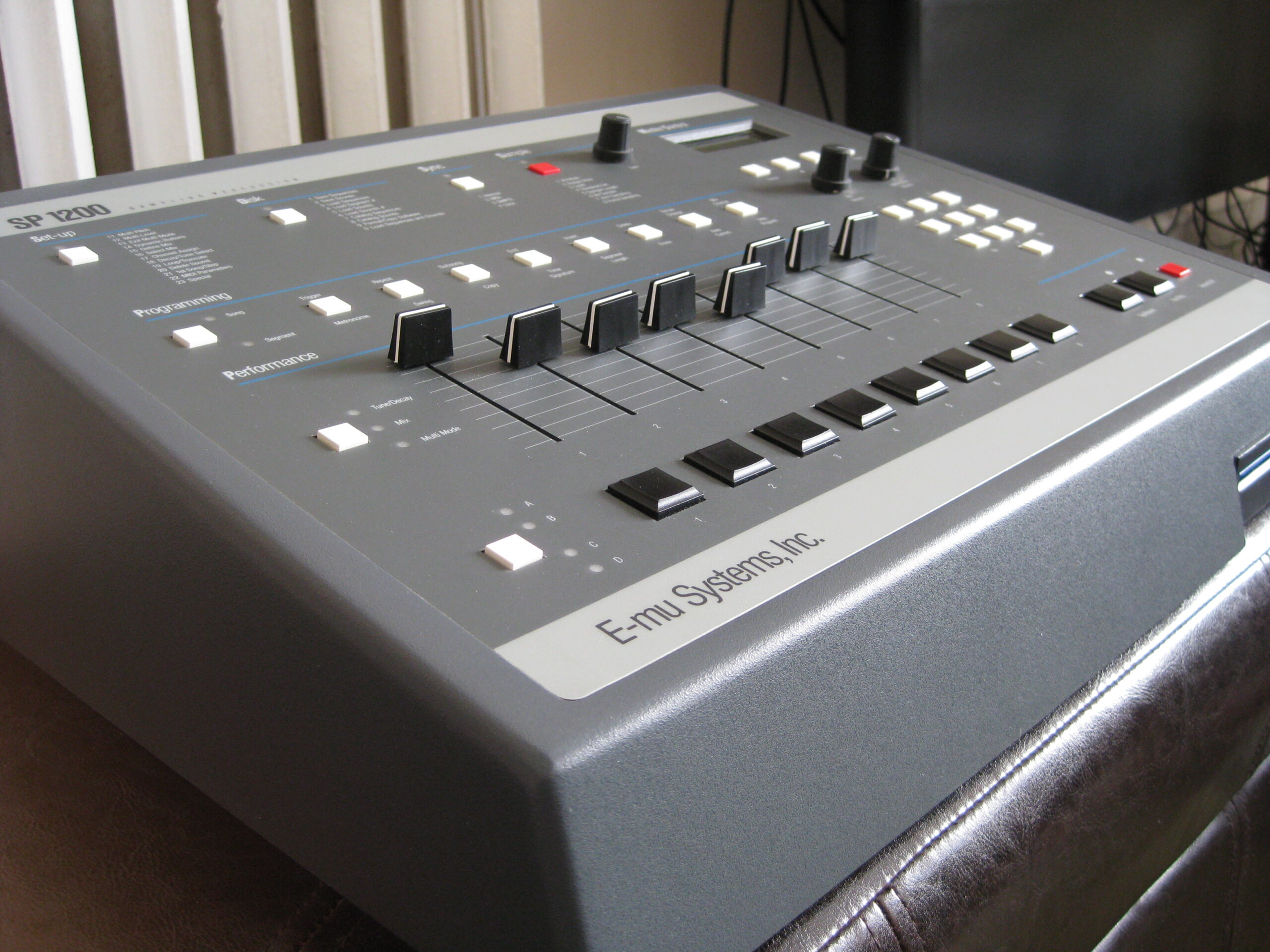
The E-mu SP-1200 was an important tool for late-1980s producers because its limited sampling memory made sound selection and editing central creative decisions. A short drum hit or horn stab could be pitched, cut and placed in a pattern with a new rhythmic function. Ced-Gee’s discussion of that instrument in SPIN’s retrospective interview is a useful account of how tools and musical ideas interacted. The equipment did not create a finished song on its own, and it should not be treated as a magical explanation for every interesting sound. What the limitation did provide was a workflow that rewarded deliberate decisions about the length and placement of an audio fragment.
To hear the impact, compare a sustained source phrase with the clipped attacks that appear in sample-driven rap production of this period. Listen for the moments when a fragment becomes a rhythmic accent rather than functioning as a continuous backing track. Notice how repetition makes a tiny event memorable, especially when it returns in different positions around the snare. Pitch changes can also change a source’s apparent weight and texture, but the precise settings of a specific sample should not be guessed without session evidence. The practical lesson for a modern producer is to make an arrangement from carefully chosen components rather than assuming more audio layers necessarily mean a better beat.
Drums and samples behave like separate design layers
On Critical Beatdown, the drum track often remains forceful even when the surrounding sample collage is crowded. The kick and snare give the listener a reliable frame while shorter fragments create surprise on top. A dense production can lose energy if every sound competes in the same frequency and rhythmic space. These tracks offer examples of how separation can come from timing and arrangement as much as from modern equalization. You can learn from the record without pretending that the engineers used today’s digital mixing methods.
A useful listening test is to focus on the snare for one complete section before attending to any other instrument. Next, follow the sample accents and identify whether they land on the same beats or create cross-rhythmic movement. If the drums remain legible, ask whether that is because of the source’s tone, the length of the samples or the way the parts enter and leave. You should also listen for deliberate roughness instead of assuming that every abrasive sound reflects poor recording quality. This separates an intentional production aesthetic from a general statement that an old hip-hop record sounds “hard.”
Shopping links may support PCMusicMax at no extra cost to you.
Explore modern creator gear: browse Home Studio Gear at GearReady.
Kool Keith’s writing matches the production’s unpredictability
Kool Keith’s writing is part of the arrangement rather than simply a set of words laid over it. His lines can change direction quickly through humor, strange imagery and unexpected references, leaving the listener uncertain what comes next. A straightforward production might make those changes seem disconnected, but the group’s fractured rhythmic language gives them a compatible musical setting. That does not mean the beats follow every syllable or that every lyrical image is an intentional response to a sample. It means the vocal and instrumental choices share a taste for disruption and surprise.
Listen to a full verse while marking the places where the MC emphasizes a syllable against the expected pulse. Then replay the same passage without concentrating on the words, following only the drum accents and interruptions. You may hear moments of alignment and moments when the voice deliberately seems to resist the backing track. Both are useful ways to understand flow, because an MC’s timing is defined partly by the groove against which it moves. This is a stronger explanation of artist-production fit than simply describing Kool Keith as unconventional or Ced-Gee as a futuristic producer.
Why the album is more than a “cult classic” label
Calling Critical Beatdown a cult classic does not explain the album’s musical value by itself. Its importance is easier to discuss through identifiable techniques: aggressive sample editing, unpredictable arrangement and an unusually strong connection between production and delivery. The project emerged in a period when rap recording was becoming more technically ambitious, but no single album should be described as the sole origin of that change. Instead, the group’s work belongs in a conversation involving contemporary sample-based producers and the development of the SP-1200 aesthetic. This context gives listeners a way to evaluate its ideas without relying on inflated claims about being first.
The album also rewards attention as a complete listening experience rather than a list of famous tracks. Repeated production devices and a consistent sonic personality create continuity even when individual songs change direction abruptly. A useful comparison is to ask which later records prioritize groove continuity and which prefer abrupt collage-like movement. That comparison should identify real production choices and documented influences instead of assuming every similar sound was directly copied from Ultramagnetic MCs. The measurable legacy is the ongoing usefulness of the group’s musical approach, supported by the recordings and the artists’ accounts of making them.
Sampling history should identify transformations, not just sources
A database of sample sources is helpful, but it is not a full explanation of a recorded transformation. A producer can isolate a fraction of a source, replay or pitch it, change its rhythmic placement and surround it with newly programmed drums. Those changes can make the new recording function very differently from the original material. For a particular song, the source relationship must be checked against label documentation, knowledgeable interviews or verifiable audio comparisons before becoming a factual attribution. Speculation based only on similarity should be clearly labeled as such.
For a source-to-record analysis, start by identifying the smallest audible phrase that appears to connect the two recordings. Compare the pitch, speed, spacing and timbre rather than listening only for a recognizable melody. Then check whether the new track repeats the phrase as a loop or uses it as a short punctuation mark within a different groove. That difference matters because a loop can supply the musical foundation, while a one-shot fragment can become an entirely new event. PCMusicMax should treat this distinction as research, not as an excuse to print unverified sample lists or generic production commentary.
How to study Critical Beatdown as a producer
You can study the album in a deliberate sequence rather than attempting to absorb every detail in a single listen. Begin with the drum groove and establish the basic pulse before following any sample or vocal element. Next, listen for short fragments that interrupt or answer the drums. On a third pass, pay attention to Kool Keith’s phrasing and the way line endings interact with the instrumental pattern. Repeat the process across two tracks and write down the musical differences instead of simply ranking which recording sounds stranger.
If you produce music yourself, try recreating the structural idea with legally obtained or self-recorded sounds rather than copying a commercial master. Limit yourself to a few short samples, one drum pattern and deliberate spaces where elements drop out. Make a version in which the sample runs continuously, then compare it with a version in which the same sound appears only as accents. The comparison will show whether editing, not merely the choice of sample, changes the track’s identity. That exercise develops an ear for arrangement and makes this history useful to a working creator as well as a listener.
Listen to the actual album while testing the production-analysis method. Album hosted by Spotify.
- Listen to the drums alone before chasing sample sources.
- Identify short fragments versus longer loops.
- Notice abrupt edits and changes in texture.
- Compare beat density with Kool Keith’s vocal density.
- Use the album to understand how hardware limits can become style.
Continue exploring
The most valuable follow-up is another article that teaches a distinct part of the same process rather than restating this review. Our guide to samplers, grooveboxes and drum machines explains how the tools organize music-making today. A separate producer-credits guide helps readers verify who contributed to a recording. These resources complement the Ultramagnetic story because production technique and documentary evidence are different kinds of knowledge. Together they give readers both a listening method and a practical research process.
For more direct historical context, revisit the 2023 Ced-Gee and Kool Keith interview and compare the participants’ descriptions with the recordings. Read the original release credits wherever a label scan or verified discography is available. Be cautious of attractive online diagrams that present uncertain sampling relationships as settled facts. A clear investigation should separate the primary recording, a retrospective quotation and the writer’s own interpretation. That is the difference between a durable music-history article and a page built mainly to repeat familiar internet claims.
Sources and research notes
The source record for this article combines first-person music history with listening-based analysis. SPIN’s 2023 interview supplies retrospective observations from members of the group, but such recollections should be presented as recollections rather than direct evidence of every studio detail. The 1988 album itself is the primary musical artifact, and its arrangements are the basis for observations about pacing, rhythmic separation and texture. Contemporary release documentation and authenticated credits should be consulted before making precise claims about a recording’s personnel or a particular sample. This is why the article avoids unsupported first-ever claims or exact hardware settings that are not established by a reliable source.
The purpose of a source list is to make each important claim traceable, not to make the page look academic. Readers should be able to distinguish source testimony from the editorial judgments that follow it. When a quoted participant describes a technique, the description is evidence of what that participant reported. When an author explains how a beat feels or how the sample interacts with a verse, that is analysis grounded in the recording. Both have a place here, but they should never be presented as if they were the same category of fact.
For readers checking the Ultramagnetic MCs Critical Beatdown production record, this table separates album identity, label lineage, and named production credits from the article’s listening-based interpretation. AllMusic supplies the album track listing and named production credits. Qobuz records the Roadrunner Records and Next Plateau label lineage for the release. MusicBrainz anchors the album to the group’s 1988 catalog. The SPIN interview adds firsthand context from Ced-Gee and Kool Keith without replacing the release-level evidence.
| Release check | Verified detail | Reference |
|---|---|---|
| Original album | Critical Beatdown, 1988, 15 tracks | AllMusic track listing |
| Label lineage | Roadrunner Records / Next Plateau Entertainment | Qobuz release credits |
| Production credits | Ced-Gee: producer and engineer; Paul C.: producer | AllMusic credits |
| Catalog identity | Ultramagnetic MC’s — 1988 album | MusicBrainz artist catalog |